In this article
5 Ways Coordinated Audits Strengthen SOC 2 and ISO Security
- Jorge Sandoval
Introduction: Trust Is No Longer Measured Through One Framework
Modern organizations are facing a broader trust landscape.
Customers want assurance that sensitive data is protected. Enterprise buyers want evidence of operational discipline. Investors want confidence in governance maturity. Regulators and partners want clarity around risk, accountability, and control oversight.
For many organizations, one framework is no longer enough to answer every stakeholder expectation.
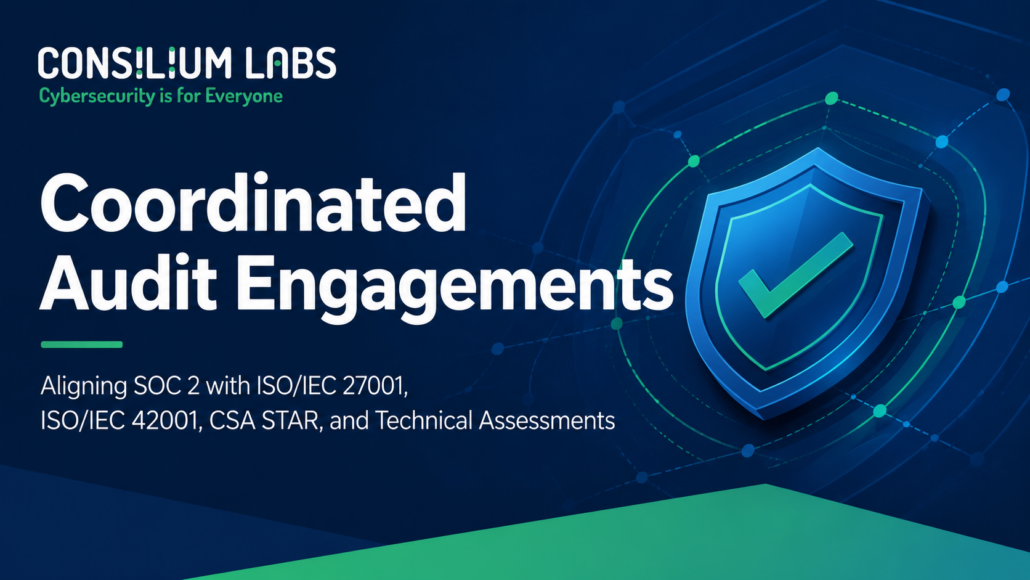
This is why coordinated audit engagements are becoming increasingly relevant. Organizations are now looking at SOC 2 alongside ISO/IEC 27001, ISO/IEC 42001, CSA STAR, SOC 3, penetration testing, and other independent assessments as part of a broader trust and governance strategy.
The goal is not to merge frameworks.
The goal is to align audit efforts while preserving the integrity, scope, and outcome of each engagement.
Why SOC 2 Is Often Paired With Other Audit Engagements
SOC 2 is highly valuable because it focuses on controls related to security, availability, processing integrity, confidentiality, and privacy. It is especially relevant for organizations that manage customer data, operate critical systems, or serve enterprise clients.
However, SOC 2 is not a certification. It results in an independent report issued by a licensed CPA.
Other frameworks serve different purposes. ISO/IEC 27001 provides certification for an information security management system. ISO/IEC 42001 addresses AI management systems. CSA STAR strengthens cloud assurance visibility. Penetration testing provides technical security evaluation of systems and environments.
Together, these engagements create a wider trust picture.
For organizations operating in complex technology, cloud, SaaS, AI, financial, healthcare, or data-driven environments, a coordinated approach can make the audit experience more structured and easier to manage internally without blending the outcomes.
What “Combined” Really Means
A combined audit approach must be defined carefully.
It does not mean one audit produces multiple outcomes automatically. It does not mean SOC 2 becomes a certification. It does not mean ISO/IEC 27001 and SOC 2 are interchangeable. It does not mean one framework proves conformance to another.
A compliant combined approach means a coordinated audit plan where related engagements are aligned in timing, communication, document review, stakeholder participation, and audit execution.
Each framework remains separate. Each scope remains defined. Each outcome remains distinct.
For example:
- ISO/IEC 27001 results in certification when requirements are satisfied.
- SOC 2 results in a report issued by an independent CPA.
- ISO/IEC 42001 results in certification for an AI management system when applicable requirements are met.
- CSA STAR provides cloud assurance recognition based on its defined structure and applicable pathway.
- Penetration testing results in a technical assessment report based on the agreed scope.
This distinction is critical because coordinated audit delivery should strengthen clarity, not create confusion.
SOC 2 and ISO/IEC 27001: A Common Trust Pairing
SOC 2 and ISO/IEC 27001 are often pursued together because both speak to security governance, control discipline, and stakeholder confidence.
ISO/IEC 27001 focuses on the establishment and operation of an information security management system. It gives organizations a globally recognized certification pathway for information security governance.
SOC 2 focuses on controls relevant to the Trust Services Criteria and provides a report that customers and enterprise buyers frequently request during vendor reviews.
When these two engagements are coordinated, organizations can approach documentation, internal participation, and audit timelines with greater structure. The engagements remain separate, but the operational burden can be managed more coherently.
This pairing is especially relevant for SaaS providers, cloud platforms, enterprise technology companies, data processors, and organizations expanding into international markets.
SOC 2 and ISO/IEC 42001: Trust in AI-Driven Operations
As AI adoption grows, organizations using or providing AI-enabled systems face stronger expectations around governance, transparency, accountability, and risk management.
SOC 2 and ISO/IEC 42001 address different dimensions of trust.
SOC 2 focuses on controls related to systems and data. ISO/IEC 42001 focuses on the management system for responsible AI governance. For organizations deploying AI products, managing machine learning pipelines, or operating AI-enabled workflows, the two engagements can create a broader view of operational and AI governance maturity.
A coordinated approach allows leadership teams to view security governance and AI governance through a more unified audit calendar, while keeping each framework’s purpose and outcome distinct.
This is particularly relevant for AI platforms, data analytics companies, automation providers, and enterprise technology organizations integrating AI into customer-facing systems
SOC 2 and CSA STAR: Cloud Trust and Customer Assurance
Cloud environments continue to shape how organizations manage data, infrastructure, access, and third-party dependencies.
CSA STAR is especially relevant for organizations operating in cloud-based ecosystems. When paired with SOC 2, it can provide a broader assurance narrative for cloud governance and customer trust.
SOC 2 addresses controls within the defined system and Trust Services Criteria. CSA STAR provides a cloud-focused assurance pathway based on the Cloud Security Alliance model and related controls.
For cloud providers, SaaS companies, infrastructure platforms, and managed service environments, coordinating SOC 2 with CSA STAR can provide customers with a clearer view of how cloud security expectations are being independently evaluated across different dimensions.
Again, the important distinction remains: the engagements may be coordinated, but the outcomes are not merged.
SOC 2 and Penetration Testing: Combining Governance and Technical Evaluation
SOC 2 evaluates controls within a defined audit scope. Penetration testing evaluates technical exposure across systems, applications, networks, or environments based on a defined testing scope.
These two activities serve different purposes, but they are often connected in buyer expectations.
Enterprise customers may ask whether an organization has both a SOC 2 report and recent technical security testing. SOC 2 communicates governance and operational control maturity. Penetration testing provides technical insight into system-level security exposure.
A coordinated schedule can give security, compliance, and leadership teams a clearer view of both governance-level assurance and technical assessment outcomes.
This pairing is especially relevant for organizations operating customer-facing platforms, APIs, cloud environments, or applications that process sensitive data.
Why Coordinated Audit Engagements Matter
The value of coordinated audit work is not only operational. It is strategic.
When multiple audit or assessment engagements are managed separately, organizations may encounter duplicate requests, scattered timelines, inconsistent messaging, and fragmented executive visibility.
A coordinated audit approach creates a more disciplined structure. Teams understand the scope. Leadership has clearer visibility. Stakeholders receive distinct but aligned trust signals. Internal teams can participate with greater clarity because the audit calendar and expectations are defined more coherently.
This does not reduce rigor. It reinforces discipline.
The strongest coordinated engagements preserve independence, maintain framework-specific boundaries, and create a clear line between each audit outcome.
The Role of Consilium Labs
Consilium Labs conducts independent, standards-based audits and assessments across multiple frameworks and technical domains.
For coordinated engagements involving SOC 2 and other frameworks, Consilium Labs provides structured audit management, objective evaluation, evidence-based assessment, and formal reporting aligned to the defined scope of each engagement.
Where SOC 2 is included, the final SOC 2 report is reviewed, signed, and issued by an independent CPA.
This structure allows organizations to pursue multiple trust objectives through a coordinated audit experience while maintaining independence, rigor, and clear separation of outcomes
Frequently Asked Questions
Is SOC 2 a certification?
No. SOC 2 is not a certification. SOC 2 results in an independent report that evaluates controls against the applicable Trust Services Criteria. The final SOC 2 report is reviewed, signed, and issued by an independent CPA.
Can SOC 2 be coordinated with ISO/IEC 27001?
Yes. SOC 2 and ISO/IEC 27001 can be coordinated within the same audit strategy, but they remain separate engagements with distinct outcomes. ISO/IEC 27001 may result in certification, while SOC 2 results in an independent report. Where appropriate, control mapping can help identify overlapping control themes and evidence areas, reducing duplicate requests and creating a more structured audit experience without merging the two frameworks or changing their separate outcomes.
Does a coordinated audit mean one framework covers another?
No. A coordinated audit approach does not mean one framework replaces or proves conformance to another. Each framework has its own scope, requirements, criteria, and outcome. Coordination refers to the structure, timing, and management of related audit activities.
Why do organizations pursue SOC 2 with ISO/IEC 27001?
Organizations often pursue both because they address different stakeholder expectations. ISO/IEC 27001 provides globally recognized information security certification, while SOC 2 is frequently requested by customers and enterprise buyers as part of vendor assurance and procurement reviews.
Can SOC 2 be aligned with ISO/IEC 42001 for AI governance?
Yes, SOC 2 and ISO/IEC 42001 can be coordinated when an organization needs to address both security assurance and AI management system requirements. The two engagements remain distinct, but a coordinated approach can give leadership a clearer structure for managing audit activities.
How does SOC 2 relate to CSA STAR?
SOC 2 and CSA STAR are often relevant for cloud and technology environments. SOC 2 evaluates controls within a defined system against the Trust Services Criteria, while CSA STAR focuses on cloud assurance based on Cloud Security Alliance requirements. They can be coordinated, but their scopes and outcomes remain separate
Can penetration testing be coordinated with SOC 2?
Yes. Penetration testing and SOC 2 serve different purposes, but they are often relevant to the same stakeholders. SOC 2 focuses on governance and controls within the defined audit scope, while penetration testing provides a technical assessment of systems, applications, networks, or environments.
What is the main benefit of coordinating multiple audit engagements?
The main benefit is clearer structure across multiple assurance activities. A coordinated approach can reduce duplicated effort, improve internal visibility, and give stakeholders distinct but aligned trust signals while preserving the independence and rigor of each engagement.
What role does Consilium Labs play in coordinated audit engagements?
Consilium Labs conducts independent, standards-based audits and assessments across defined scopes. For coordinated engagements, Consilium Labs provides structured audit management, objective evaluation, evidence-based assessment, and formal reporting aligned to each applicable framework.
Who issues the SOC 2 report?
The SOC 2 report is reviewed, signed, and issued by an independent CPA. Consilium Labs conducts and coordinates the SOC 2 audit engagement while maintaining clear separation from the CPA’s attestation role.
Conclusion: One Strategy, Multiple Trust Outcomes
Organizations are no longer evaluated through a single lens.
Security, privacy, cloud, AI, and operational governance expectations are converging. Customers want stronger evidence. Procurement teams want clearer assurance. Leadership teams want better visibility into organizational maturity.
A coordinated audit approach allows organizations to address these expectations with structure and discipline.
SOC 2 can sit alongside ISO/IEC 27001, ISO/IEC 42001, CSA STAR, SOC 3, penetration testing, and other independent assessments as part of a broader trust strategy.
The key is precision.
Each engagement must remain distinct. Each outcome must remain accurate. Each framework must retain its own purpose.
When done correctly, coordinated audit engagements create a stronger, clearer, and more credible way to demonstrate trust across modern business environments.
Ready to explore a coordinated audit engagement?
Meet with Consilium Labs to discuss how SOC 2 and other assurance frameworks can be aligned under a structured, independent audit approach:


Related Articles
Let's get in touch
Start your audit now. Achieving cybersecurity audit can be complex. We have made it our mission to simplify the process, giving you access to the professional expertise you need to prepare your company for the future. Get in touch with us today!