In this article
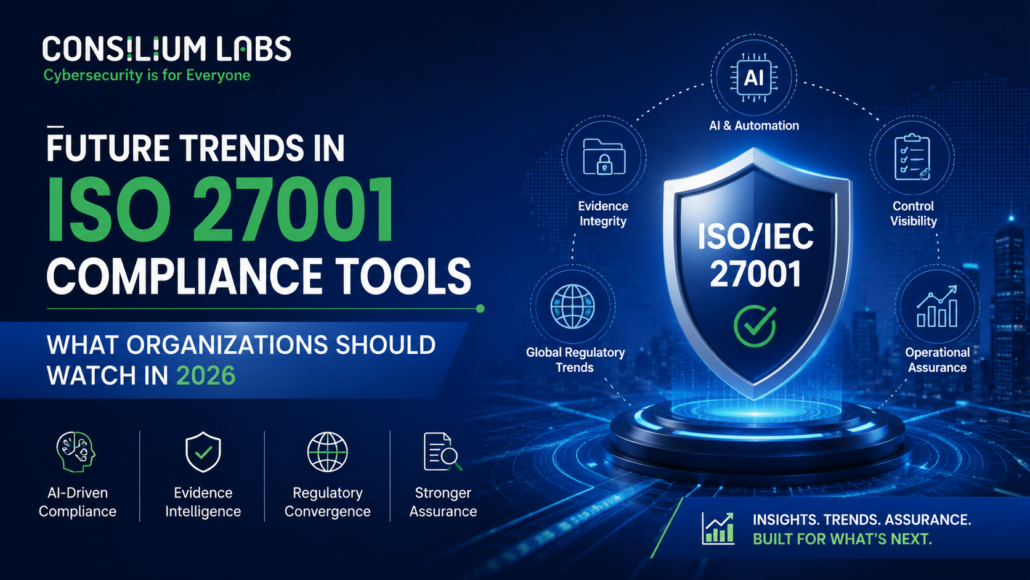
How to Choose the Best ISO 27001 Compliance Tools for 2026
- Elad Motola
Introduction: The Compliance Tool Market Is Changing
The discussion around ISO 27001 compliance tools is no longer just about efficiency or documentation. The more important question is whether these platforms are becoming reliable infrastructure for evidence integrity, traceability, and recognized assurance outcomes.
That distinction matters because ISO is clear about certification: certification is written assurance provided by an independent body that a product, service, or system meets specific requirements. In other words, software may organize evidence and workflows, but it does not replace independent certification or accredited audit activity.
As more organizations rely on cloud systems, distributed operations, and AI-enabled processes, ISO 27001 platforms are being evaluated against a different standard. Buyers are not only asking whether a platform centralizes policies and tasks. They are asking whether it preserves evidence in a way that stands up to external scrutiny.
Prediction 1: AI Will Shift Compliance Platforms Toward Evidence Intelligence
The next phase of ISO 27001 tooling will likely center on how platforms interpret and organize evidence, not just how they assign tasks. Many tools already centralize policy records, approvals, and evidence libraries. The stronger platforms in 2026 will likely distinguish themselves by identifying inconsistencies across control records, surfacing evidence gaps in context, and improving visibility into ownership and approval history.
This trend aligns with the broader direction of AI risk management. NIST’s AI Risk Management Framework emphasizes trustworthiness and a structured lifecycle approach to the design, development, use, and evaluation of AI systems. As a result, organizations are increasingly likely to expect compliance tooling to produce records that are not only accessible, but coherent and traceable.
Prediction 2: Regulatory Convergence Will Put Pressure on Tool Architecture
The second major trend is regulatory overlap. The NIS2 Directive establishes a unified legal framework for cybersecurity across 18 critical sectors in the EU. At the same time, the EU AI Act has entered into force, with key obligations phasing in through 2026 and beyond with key obligations phasing in through 2026 and beyond. These developments create pressure on organizations to maintain evidence that can be mapped across multiple legal and assurance expectations without blurring the differences between them.
This is where many tools will be tested. It is one thing to collect documents. It is another to preserve scope clarity across information security, supplier oversight, incident management, AI governance, and other overlapping domains. The stronger platforms will be the ones that allow control mapping without collapsing distinct obligations into a single generic narrative.
Prediction 3: Operational Assurance Will Matter More Than Policy Completeness
There is a growing difference between having a polished compliance workspace and maintaining a defensible evidence trail. Procurement teams, boards, and regulators increasingly want proof that controls exist and function in practice. That means policy libraries alone are not enough.
ISO positions certification as independent written assurance, and that makes evidence quality a central issue. Platforms that preserve approval history, evidence lineage, change records, and ownership clarity are likely to become more relevant than platforms that primarily emphasize convenience. In external audit environments, the quality of the record often matters more than the appearance of the interface.
Prediction 4: ISO 27001 Tooling Will Sit Closer to AI Governance
Another likely development is that ISO 27001 tooling will increasingly be discussed alongside AI governance rather than separately from it. NIST’s work on AI trustworthiness and lifecycle risk management has already shifted expectations about how organizations manage AI-related exposure. In practice, issues such as model change control, data handling, human oversight, and system integrity now sit much closer to information security management than they did even two years ago.
That does not mean ISO 27001 becomes an AI standard. It means that information security evidence will increasingly be expected to coexist with broader governance evidence in environments where AI capabilities are embedded in products and operations.
What Organizations Should Evaluate in a Compliance Platform
From an assessment perspective, four questions are becoming more important.
First, does the platform preserve evidence integrity in a way that can be independently evaluated?
Second, does it clearly distinguish control ownership and approval history?
Third, can it map controls across obligations without erasing important scope boundaries?
Fourth, does it create records that remain coherent under external audit scrutiny?
Those questions are becoming more relevant than broad product claims. In 2026, the market is likely to place greater weight on visibility, traceability, and record defensibility than on workflow convenience alone.
Final Thought
The future of ISO 27001 compliance tooling is not only about automation. It is about whether platforms can serve as credible infrastructure for trust.
Organizations will continue to use software to organize their management systems, but recognized assurance outcomes still depend on independent assessment. That is why the most consequential developments in this market will center on evidence quality, control traceability, and alignment with expanding regulatory expectations.
The next phase of the market will not be won by the loudest platform. It will be shaped by the platforms that make independent evaluation more coherent, more transparent, and more defensible.


Related Articles
Let's get in touch
Start your audit now. Achieving cybersecurity audit can be complex. We have made it our mission to simplify the process, giving you access to the professional expertise you need to prepare your company for the future. Get in touch with us today!