In this article
Practical Steps for Continuous Compliance in Regulated Markets
- Sajjad Syed
What Is Continuous Compliance?
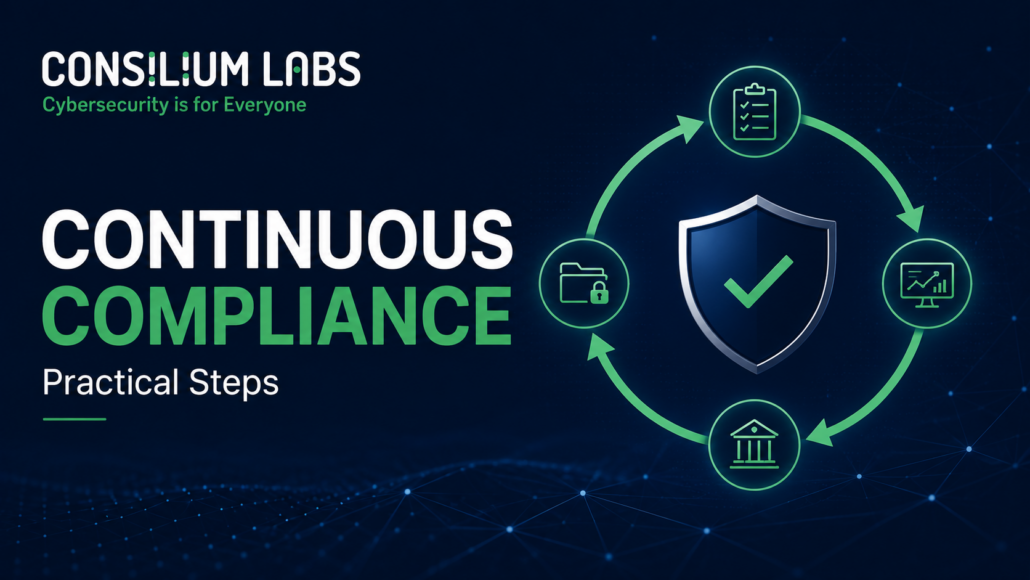
Continuous compliance is the practice of defined ownership, monitoring records, and governance oversight across the year rather than reconstructing compliance activity near a formal assessment window.
Traditional compliance activity is often periodic. A customer request arrives, a certification audit begins, a regulator asks for records, or a board report becomes due. Teams then gather policies, access records, training data, supplier files, risk records, and technical evidence from multiple systems.
Continuous compliance changes the operating model.
Instead of treating compliance as a recurring documentation event, organizations maintain a clearer view of:
- which obligations apply
- who owns each major control domain
- where evidence originates
- how exceptions are identified
- which suppliers affect the compliance scope
- how leadership reviews risk and compliance information
- how records can be evaluated under independent assessment
This approach does not replace formal audits, certifications, or technical assessments. It creates a more current internal evidence environment that can be evaluated against defined criteria.
How Is Continuous Compliance Different From Compliance?
Compliance refers to alignment with applicable laws, standards, contracts, policies, or framework requirements. Continuous compliance refers to the ongoing maintenance of evidence, oversight, and monitoring practices related to those obligations.
A traditional compliance model may confirm that a policy exists. A continuous compliance model asks whether the policy is current, owned, communicated, reviewed, and connected to evidence.
A traditional model may confirm that access reviews occur. A continuous model asks whether those reviews follow a defined cadence, whether exceptions are recorded, whether evidence is retained, and whether leadership can see recurring patterns.
A traditional model may confirm that supplier reviews exist. A continuous model asks whether critical suppliers are tracked, whether review records are current, whether third-party exposure appears in governance reporting, and whether supplier evidence remains traceable.
The difference is visibility.
Compliance can be demonstrated through records at a point in time. Continuous compliance focuses on whether those records remain structured, current, and connected to governance activity throughout the year.
Why Does Continuous Compliance Matter in 2026?
Continuous compliance matters because organizations are operating under greater pressure from regulatory frameworks, enterprise buyers, boards, and third-party risk expectations.
Regulatory frameworks increasingly emphasize cybersecurity risk management, operational resilience, privacy safeguards, supplier oversight, and governance accountability. NIST’s continuous monitoring publication focuses on visibility into assets, vulnerabilities, threats, and the effectiveness of deployed security controls. NIST Cybersecurity Framework also places governance at the center of cybersecurity risk management.
In Europe, NIS2 raises expectations around cybersecurity risk management and supply chain security for entities within scope. In healthcare, the HIPAA Security Rule requires administrative, physical, and technical safeguards for electronic protected health information.
These examples point to the same direction: organizations need structured evidence and oversight. They need to show how controls, records, suppliers, and risks are governed over time.
For SaaS companies, technology-enabled enterprises, healthcare vendors, financial institutions, and AI-enabled organizations, continuous compliance is becoming a leadership issue. It connects operational activity to governance visibility.
What Are the Core Components of Continuous Compliance?
A practical continuous compliance model usually includes six connected components.
1. Scope and Obligation Mapping
Continuous compliance begins with scope. Organizations need to know which business units, products, systems, regions, suppliers, and data categories are included.
Without scope clarity, evidence becomes scattered. Teams may collect records that do not matter while missing records that directly affect the assessment scope.
Scope and obligation mapping should clarify:
- which frameworks apply
- which systems are included
- which teams own obligations
- which suppliers affect the environment
- which records demonstrate activity
- which requirements require recurring review
2. Ownership and Accountability
Every major obligation needs an owner. Every evidence stream needs a responsible team. Every recurring review should have defined accountability.
Continuous compliance becomes weak when ownership is informal. A policy may exist, but no one owns its review. Supplier records may exist, but no one confirms currency. Training may occur, but no one maps it to role-level obligations.
Clear ownership allows leadership to see whether compliance is functioning as a governed system.
3. Evidence Architecture
Evidence architecture refers to how records are structured, stored, named, retained, and connected to requirements.
This includes:
- policy records
- access reviews
- risk assessments
- supplier reviews
- training records
- vulnerability records
- incident records
- management review records
- technical monitoring records
- system inventories
Evidence should be traceable. A reviewer should be able to connect the record to a requirement, scope area, owner, date, and review activity.
4. Monitoring and Exception Visibility
Continuous compliance depends on visibility into exceptions.
Monitoring records may show stale evidence, overdue reviews, unresolved access exceptions, critical supplier review gaps, vulnerability exposure, control failures, or repeated nonconformities.
Monitoring does not need to create excessive noise. It should produce risk-relevant information that can be reviewed by the right owners and elevated when necessary.
The key question is simple: can leadership see material compliance and risk signals in time to govern effectively?
5. Automation Tools and Workflow Records
Automation tools can strengthen evidence visibility when they are used to record, organize, classify, and monitor compliance-related activity.
Examples may include:
- identity and access management tools
- ticketing systems
- governance, risk, and compliance platforms
- vulnerability management tools
- cloud configuration monitoring
- supplier management systems
- learning management systems
- policy acknowledgment tools
- asset inventory systems
Automation tools should not be treated as a substitute for governance. A dashboard does not equal oversight. A workflow does not equal accountability. A tool is useful when it creates reliable records, clear ownership, and evidence that can be evaluated.
6. Governance Review
Continuous compliance requires review by leadership or designated governance bodies.
Governance review may include:
- recurring risk reporting
- supplier exposure reporting
- access review trends
- training coverage
- exception closure status
- repeated nonconformities
- changes in regulatory exposure
- assessment findings
Governance review converts technical and operational records into leadership visibility.
What Practical Steps Can Organizations Evaluate Internally?
Organizations can begin by examining whether their current compliance operating model is structured, traceable, and reviewable.
A practical internal evaluation may include the following steps:
- Define the scope.
Identify the systems, processes, teams, suppliers, and locations connected to each compliance obligation. - Map obligations to owners.
Assign responsibility for each major requirement, record type, and review activity. - Identify authoritative evidence sources.
Determine where records originate and which systems should be treated as reliable sources. - Review evidence currency.
Check whether records are current within the defined review period. - Evaluate exception visibility.
Determine whether unresolved issues, repeated findings, and stale evidence are visible to the right owners. - Connect supplier records to scope.
Identify third parties that affect security, privacy, operational resilience, AI systems, or data processing obligations. - Review training records by role.
Determine whether training evidence maps to employee responsibilities and applicable obligations. - Link monitoring to governance reporting.
Ensure leadership receives structured reporting that reflects material risk and compliance signals. - Separate internal monitoring from independent assessment.
Internal compliance activity and independent evaluation serve different purposes. - Maintain accurate external claims.
Communicate certifications, audit reports, and assessment outcomes with precision.
Sample Industry Use Cases
SaaS and Cloud Services
A B2B SaaS company selling into enterprise environments may face customer assurance requests related to ISO/IEC 27001, SOC 2, CSA STAR, privacy practices, and third-party risk.
A continuous compliance model gives leadership a clearer view of access reviews, supplier records, technical monitoring, evidence currency, and assessment history.
The key maturity signal is not the presence of documents alone. It is the ability to show that records are current, scoped, owned, and connected to governance review.
Healthcare Technology
A healthcare technology provider handling sensitive data may need structured records related to access control, workforce training, vendor oversight, incident activity, and safeguards for electronic protected health information.
Continuous compliance can strengthen evidence visibility by connecting training records, access reviews, system documentation, supplier records, and leadership review activity.
For healthcare environments, the most important question is whether evidence remains current and traceable to defined responsibilities.
Financial Services and Fintech
Financial services and fintech organizations often operate under heightened expectations for cybersecurity, operational resilience, supplier oversight, and data governance.
Continuous compliance can create a clearer view of risk records, third-party dependencies, incident activity, control reviews, and leadership reporting.
For these organizations, continuous oversight is especially important because regulatory expectations and third-party dependencies can change quickly.
AI-Enabled Organizations
Organizations using AI for decision-making, analytics, fraud detection, customer interaction, or operational automation need structured records for AI system scope, ownership, training, monitoring, risk evaluation, and human involvement.
Continuous compliance can connect AI governance records with broader risk management and evidence practices.
This becomes increasingly relevant as AI governance expectations expand across sectors.
What Are the Key Benefits of Continuous Compliance?
Continuous compliance can strengthen governance visibility, evidence quality, risk management, and assessment clarity.
The key benefits include:
- clearer ownership of obligations
- better evidence traceability
- stronger visibility into exceptions
- more consistent leadership reporting
- clearer supplier oversight
- reduced dependence on last-minute evidence reconstruction
- stronger distinction between internal records and independent assessment outcomes
- more accurate communication with customers and external stakeholders
These benefits are strongest when continuous compliance is treated as a governance discipline, not as a technology purchase alone.
How Does Independent Assessment Fit Into Continuous Compliance?
Independent assessment evaluates evidence against defined criteria within an agreed scope.
Continuous compliance is an internal operating condition. It may make evidence more current, structured, and visible. But it does not replace objective evaluation.
An organization may maintain strong internal monitoring and still require independent assessment to evaluate conformity against a standard or framework. That distinction is essential.
Consilium Labs conducts independent assessments against applicable standards and frameworks. Its role is to evaluate evidence within the defined scope and issue formal audit reports documenting conformities and nonconformities.
Consilium Labs does not design controls, manage internal compliance activity, or perform remediation work for the organization being assessed. Its role ends at objective, standards-based assessment.
FAQ
What are the first steps toward continuous compliance?
The first steps are defining scope, mapping obligations, assigning ownership, identifying evidence sources, and establishing review cadence for key records.
What is the difference between compliance and continuous compliance?
Compliance refers to alignment with applicable requirements. Continuous compliance refers to maintaining current evidence, monitoring, and governance visibility across time.
Which tools are commonly used in continuous compliance?
Organizations may use governance, risk, and compliance platforms, identity management tools, vulnerability management systems, cloud monitoring tools, ticketing systems, learning management systems, supplier management systems, and asset inventories.
Does automation create continuous compliance?
No. Automation tools may improve record visibility and evidence consistency, but governance, ownership, review, and independent assessment remain necessary.
What regulatory frameworks relate to continuous compliance?
Relevant frameworks may include NIST SP 800-137, NIST Cybersecurity Framework 2.0, NIS2, HIPAA Security Rule requirements, ISO/IEC 27001, ISO/IEC 42001, SOC 2 criteria, and sector-specific obligations.
Can continuous compliance replace audits or certifications?
No. Continuous compliance is an internal operating model. Formal audits, certifications, examinations, and technical assessments remain separate activities with defined criteria and outcomes.
How should leadership evaluate continuous compliance?
Leadership should review evidence currency, ownership, supplier exposure, material exceptions, repeated nonconformities, training coverage, and whether monitoring information appears in governance reporting.
Final Thought
Continuous compliance is becoming a defining feature of modern governance.
As regulatory frameworks, enterprise buyers, boards, and customers expect stronger evidence visibility, organizations need more than periodic record collection. They need structured ownership, continuous oversight, reliable evidence, and leadership reporting that reflects the real operating environment.
For organizations working across cybersecurity, privacy, supplier oversight, AI governance, and regulated technology markets, continuous compliance can make internal governance more visible and reviewable.
Consilium Labs conducts independent, standards-based assessments against applicable frameworks, documenting conformities and nonconformities through formal audit and assessment activity.
Related Articles


Let's get in touch
Start your audit now. Achieving cybersecurity audit can be complex. We have made it our mission to simplify the process, giving you access to the professional expertise you need to prepare your company for the future. Get in touch with us today!