In this article
How to Achieve ISO 42001 Certification: A Step-by-Step Guide
- Jorge Sandoval
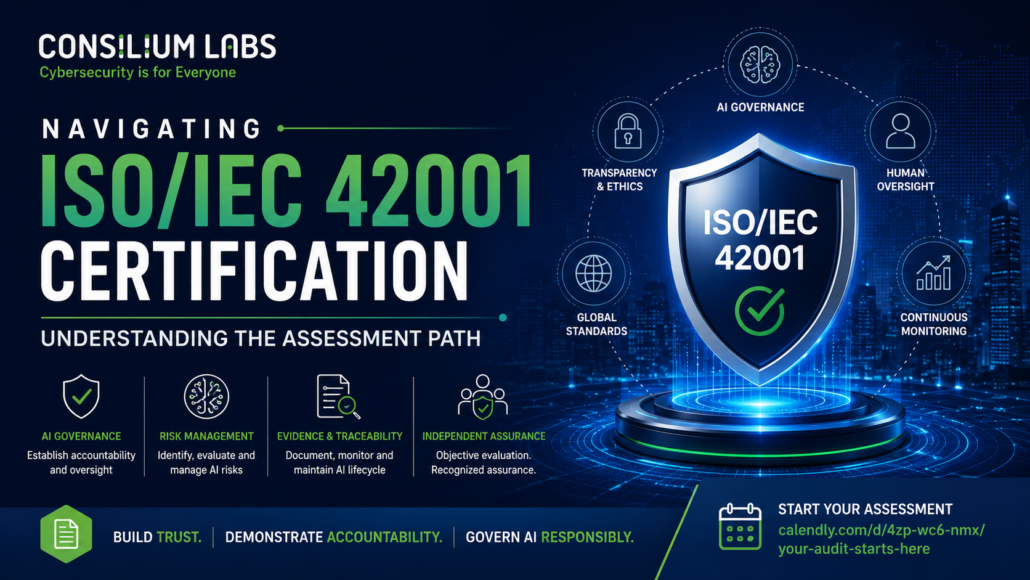
Introduction
Artificial intelligence is becoming embedded in products, operations, decision-making, and customer interactions across nearly every industry.
Healthcare organizations use AI to analyze clinical information. Financial institutions apply it to fraud detection and risk scoring. Manufacturers use predictive models to monitor equipment and production environments. Retailers depend on AI for forecasting and personalization. Professional services firms increasingly use generative AI to analyze data, summarize information, and automate routine workflows.
As AI adoption expands, one question is becoming increasingly important:
How can organizations demonstrate that their AI systems are governed responsibly?
ISO/IEC 42001 provides a structured answer.
The standard establishes requirements for an Artificial Intelligence Management System, commonly referred to as an AIMS. It gives organizations a formal governance framework for managing AI-related responsibilities, risks, processes, and oversight mechanisms.
Certification provides independent validation that an organization’s AIMS has been evaluated against the applicable requirements of the standard.
Why ISO/IEC 42001 Certification Requires a Structured Approach
AI governance is not limited to technical performance.
An effective AI Management System must account for broader questions:
- Who is accountable for AI-related decisions?
- How are AI risks identified and documented?
- What records demonstrate oversight?
- How are data quality, transparency, and human involvement addressed?
- How does the organization monitor AI systems over time?
- Can decisions be traced through documented processes?
These questions apply whether an organization develops its own AI systems, integrates third-party tools, or uses AI within internal operations.
ISO/IEC 42001 creates a management-system structure for answering them consistently.
The first stage begins with understanding how AI is used within the organization.
This includes identifying relevant products, services, internal processes, stakeholders, and regulatory considerations. Organizations must also define the scope of the AIMS clearly.
Scope definition matters because AI environments can be complex. A company may use AI in customer-facing products, internal automation, data analytics, or third-party platforms. A clearly defined scope creates the foundation for a coherent assessment.
ISO/IEC 42001 places strong emphasis on governance.
Organizations should be able to demonstrate clear ownership of AI-related responsibilities. This may involve leadership oversight, documented roles, risk ownership, approval processes, and escalation pathways.
The objective is not simply to show that AI tools exist. It is to demonstrate that the organization understands who is accountable for how those tools are used, monitored, and evaluated.
AI systems introduce risks that differ from traditional software environments.
These may include bias, limited explainability, inappropriate use, data quality concerns, privacy exposure, model drift, and unintended outcomes.
A structured AIMS requires organizations to identify relevant risks and document how those risks are evaluated within the defined scope. The quality of this documentation matters. Risk records should be clear, consistent, and connected to the AI systems being assessed.
Stage 4: Documenting Lifecycle Controls
AI governance must extend across the lifecycle of an AI system.
This may include acquisition, design, development, deployment, monitoring, changes, and retirement. Organizations should maintain records that demonstrate how oversight is applied at relevant stages.
Documentation is especially important when multiple teams, vendors, or platforms are involved. Without traceability, it becomes difficult to determine how decisions were made or whether governance processes were applied consistently.
Before an independent certification assessment, organizations typically conduct internal reviews of the AIMS.
These activities allow leadership to evaluate whether governance structures are operating as defined. Management oversight is important because ISO/IEC 42001 is not limited to technical teams. It is an organizational governance standard.
Leadership involvement demonstrates that AI-related responsibilities are understood at the appropriate level.
During an ISO/IEC 42001 certification assessment, auditors evaluate the AIMS against the applicable requirements of the standard.
This includes evidence review, interviews, scope evaluation, and assessment of documented processes. The result is a formal audit report documenting conformities and nonconformities.
Consilium Labs conducts independent, evidence-based ISO/IEC 42001 assessments. Our role is to evaluate the defined AIMS objectively against the applicable standard and issue documented findings through a structured audit process.
Organizations pursuing ISO/IEC 42001 certification often encounter recurring challenges:
- AI inventories that do not clearly identify all systems within scope
- Unclear ownership of AI-related decisions
- Fragmented documentation across technical and business teams
- Limited traceability between risks, controls, and records
- Inconsistent oversight of third-party AI tools
- Weak evidence of management-level review
These challenges are not limited to one industry. They reflect the broader complexity of governing AI responsibly.
Organizations with mature AI governance environments tend to demonstrate several consistent characteristics:
- Clearly defined scope
- Documented accountability
- Traceable risk records
- Lifecycle-based oversight
- Consistent evidence management
- Leadership-level review
- Defined human involvement in significant AI decisions
The common theme is discipline.
Responsible AI governance is not established through isolated policies. It is demonstrated through a coherent management system that connects responsibilities, risks, processes, and evidence.
ISO/IEC 42001 certification gives organizations a recognized framework for demonstrating responsible AI governance.
As AI becomes more influential across industries, independent validation will become increasingly important for organizations seeking to demonstrate accountability, transparency, and trust.
Consilium Labs conducts independent ISO/IEC 42001 assessments against applicable requirements and issues formal audit reports documenting conformities and nonconformities.
Ready to prove your competitive edge and scale with confidence?
 Schedule your ISO 42001 certification audit with Consilium Labs today.
FAQs About ISO 27001 Auditors and Audits
What does an ISO 27001 auditor do?
An ISO 27001 auditor assesses your organization’s compliance with the standard. They check your ISMS, documentation, and the effectiveness of your Annex A controls to determine if you meet certification requirements.
How long does an ISO 27001 audit take?
The audit process can vary depending on the size and complexity of your business, but typically the full process, including both stages, can take a few weeks.
What happens if we fail the audit?
If you fail the audit, your auditor will provide a report highlighting areas of noncompliance. You’ll have time to address these issues and schedule a follow-up audit.
FAQs About Consilium Labs
Who is Consilium Labs and how do they help with ISO 27001 certification?
At Consilium Labs, we put our clients first by simplifying the entire ISO 27001 certification process. By offering audits for ISO 27001, we ensure a smooth and efficient experience by narrowing down the audit scope. As an accredited Certification Body, we handle the complexities, giving you peace of mind while we help you achieve ISO 27001 compliance. This way, your team can concentrate on more pressing concerns while we manage the details of your audit and compliance needs.
Can Consilium Labs help us with compliance beyond ISO 27001?
Absolutely! Consilium Labs supports various standards within the ISO 27000 family, including ISO 27701, ISO 27017, and ISO 27018, all aimed at strengthening your organization’s information security management systems (ISMS). We also offer audits for frameworks like ISO 42001, SOC 2, Penetration Testing, and MS SSPA Services, tailored to fit your unique business needs.
Related Articles


Let's get in touch
Start your audit now. Achieving cybersecurity audit can be complex. We have made it our mission to simplify the process, giving you access to the professional expertise you need to prepare your company for the future. Get in touch with us today!

