In this article
How Independent NIST Assessments Build Security and Trust
- Sajjad Syed
Inspection Body Evaluation in a More Complex Cybersecurity Environment
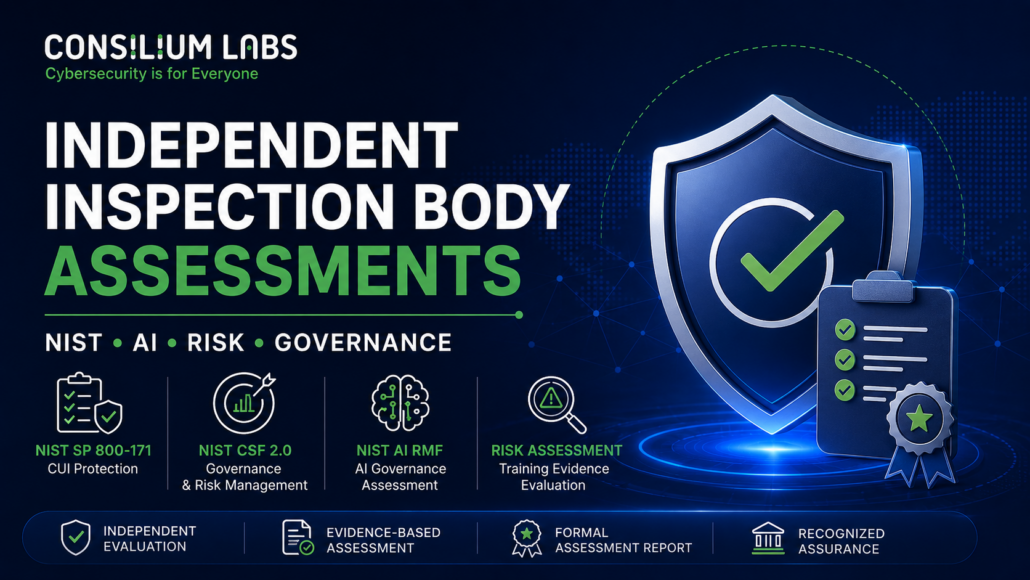
NIST Cybersecurity Assessment has become increasingly important for SaaS companies, federal supply chain participants, AI-enabled platforms, and technology-driven enterprises. Consilium Labs conducts independent, evidence-based assessments as an inspection body, evaluating cybersecurity governance, risk assessment processes, AI oversight, and technical control environments against defined criteria and objective evidence.
For SaaS companies, defense supply chain participants, AI-enabled platforms, and technology-driven enterprises, recognized frameworks such as NIST SP 800-171, NIST CSF 2.0, and the NIST AI Risk Management Framework provide structured criteria for evaluating cybersecurity and governance practices.
Consilium Labs conducts independent, evidence-based assessments as an inspection body. Each engagement is defined by scope, criteria, objective evidence, and formal reporting. The result is a documented assessment outcome that records conformity and nonconformity against applicable requirements.
This inspection model is particularly relevant for organizations that require structured validation across cybersecurity governance, risk assessment processes, AI oversight, and technical control environments.
NIST SP 800-171 Assessment: Evaluating CUI Protection
NIST SP 800-171 defines security requirements for protecting Controlled Unclassified Information, commonly referred to as CUI, within non-federal systems and organizations. These requirements are organized across control families such as access control, audit and accountability, configuration management, incident response, risk assessment, security awareness, and system integrity.
A NIST SP 800-171 assessment conducted by Consilium Labs evaluates whether the defined requirements are implemented within the stated system boundary. The assessment examines documentation, technical evidence, process records, and implementation artifacts that demonstrate how controls operate in practice.
This may include review of System Security Plans, access control records, configuration baselines, incident response documentation, risk assessment outputs, user training records, and other evidence relevant to the defined scope.
The assessment concludes with formal reporting that documents observed conformity and nonconformity against applicable requirements.
Use Case Scenario: SaaS Provider in the Federal Supply Chain
A SaaS organization provides workflow automation software to customers that operate under federal contract requirements. Certain customer data may be classified as CUI depending on contract terms and system usage.
In this scenario, a NIST SP 800-171 assessment may examine:
- Whether the CUI boundary is clearly defined
- Whether access control requirements are implemented for users and administrators
- Whether audit logs and monitoring records are retained according to defined requirements
- Whether risk assessment activities are documented
- Whether incident response procedures are formally established and evidenced
The assessment provides a structured view of how the organization’s environment aligns with NIST SP 800-171 requirements within the defined scope.
Risk Assessment Training Evaluation Under NIST SP 800-171
Risk assessment is a core component of NIST SP 800-171. Organizations handling CUI must demonstrate that risks are identified, evaluated, and managed through documented processes. In many environments, this also requires evidence that relevant personnel understand their responsibilities within the risk assessment process.
Where risk assessment training is included within the assessment scope, Consilium Labs evaluates records and evidence showing how risk assessment responsibilities are communicated, assigned, and maintained across relevant roles.
This may include review of training materials, attendance records, role-based responsibility matrices, risk assessment procedures, and evidence showing that risk-related activities are performed consistently within the defined environment.
The purpose of this evaluation is to determine whether training-related evidence aligns with the organization’s documented risk assessment process and applicable NIST SP 800-171 requirements.
Use Case Scenario: Security and Operations Teams With Defined Risk Roles
A technology company assigns risk assessment responsibilities across security, infrastructure, and operations teams. The organization maintains a documented risk assessment procedure, but leadership requires independent assessment of whether training evidence aligns with stated responsibilities.
In this scenario, the assessment may examine whether personnel assigned to risk-related activities received relevant training, whether records are retained, and whether the training content corresponds to the organization’s defined process for identifying, analyzing, and documenting cybersecurity risks.
The resulting assessment report documents the evidence reviewed and records conformity and nonconformity against the applicable criteria.
NIST CSF 2.0 Assessment: Governance-Centered Cybersecurity Evaluation
NIST CSF 2.0 expands the cybersecurity conversation by placing governance at the center of cybersecurity risk management. The framework includes the Govern function, along with Identify, Protect, Detect, Respond, and Recover.
This structure reflects the reality that cybersecurity is an enterprise risk issue. Evaluation under NIST CSF 2.0 examines how cybersecurity risk is integrated into leadership oversight, policy structures, performance monitoring, and organizational decision-making.
A Consilium Labs assessment aligned with NIST CSF 2.0 examines evidence such as governance documentation, risk registers, cybersecurity objectives, policies, monitoring outputs, incident response records, and recovery procedures.
The assessment maps observed evidence to applicable CSF functions and categories, producing a structured report that reflects the organization’s conformity posture within the defined scope.
Use Case Scenario: Enterprise Leadership Seeking Cybersecurity Governance Visibility
A mid-sized enterprise has adopted NIST CSF 2.0 as its cybersecurity governance framework. Leadership wants an independent assessment of how cybersecurity risk management aligns with board-level oversight, operational procedures, and incident response structures.
The assessment may examine whether cybersecurity roles are defined, whether risks are tracked through enterprise governance channels, whether response and recovery processes are documented, and whether monitoring practices align with stated cybersecurity objectives.
The resulting report provides documented findings against the selected CSF 2.0 criteria.
NIST AI Risk Management Framework Assessment
Artificial intelligence introduces new governance requirements related to transparency, accountability, reliability, data integrity, model oversight, and risk management. The NIST AI Risk Management Framework provides a structured model for identifying, measuring, and managing AI-related risks.
A NIST AI assessment conducted by Consilium Labs evaluates whether AI governance structures, risk processes, documentation practices, and monitoring mechanisms are established within the defined scope.
This may include examination of AI system inventories, model lifecycle documentation, risk categorization records, oversight responsibilities, testing records, monitoring procedures, and documentation addressing reliability, transparency, and bias-related considerations.
The assessment is grounded in objective evidence and produces formal reporting that documents conformity and nonconformity against the selected criteria.
Use Case Scenario: AI-Enabled SaaS Platform
An AI-enabled SaaS company deploys machine learning features that influence automated recommendations for enterprise customers. The organization has established an AI governance structure, but requires independent assessment of whether its documentation and oversight mechanisms align with the NIST AI Risk Management Framework.
The assessment may examine whether AI system roles are defined, whether model risks are categorized, whether testing records exist, and whether monitoring practices are documented for deployed AI features.
The resulting report provides an evidence-based assessment of AI governance practices within the defined scope.
How These Assessments Work Together
NIST SP 800-171, NIST CSF 2.0, and the NIST AI Risk Management Framework address different but connected parts of cybersecurity and governance.
NIST SP 800-171 focuses on security requirements for protecting CUI. NIST CSF 2.0 provides a broader enterprise cybersecurity governance structure. The NIST AI Risk Management Framework addresses the distinct risks introduced by AI systems.
For many organizations, these frameworks intersect. A SaaS company may handle regulated data, operate within customer procurement requirements, use AI features, and rely on enterprise cybersecurity governance processes. In such environments, independent assessment can provide a structured view of how different frameworks apply across the organization.
Consilium Labs conducts assessments within defined scope boundaries, using evidence-based methods and formal reporting. Each framework remains distinct. Each assessment scope remains defined. Each outcome remains tied to the applicable criteria.
Practical Scenarios Across Common Business Environments
Scenario 1: Defense Supply Chain Technology Provider
A technology provider serving prime contractors requires assessment against NIST SP 800-171 due to CUI-related contractual obligations. The assessment focuses on security requirements within the defined system boundary and produces a formal report documenting conformity and nonconformity.
Scenario 2: SaaS Company Expanding Enterprise Governance
A SaaS organization uses NIST CSF 2.0 to structure cybersecurity governance. The assessment examines how leadership oversight, cybersecurity risk management, incident response, and recovery processes align with the selected CSF functions and categories.
Scenario 3: AI Product Team Requiring Governance Evaluation
An organization deploying AI-enabled features requires assessment aligned with the NIST AI Risk Management Framework. The assessment examines governance records, AI risk categorization, model lifecycle documentation, and monitoring evidence.
Scenario 4: Risk Assessment Training Evidence Review
A security organization assigns risk responsibilities to multiple teams and maintains training records tied to those roles. Within a NIST SP 800-171 assessment scope, Consilium Labs evaluates whether training evidence aligns with documented risk assessment responsibilities and applicable requirements.
Why Inspection Body Assessment Matters
In compliance-driven and enterprise environments, internal statements alone may carry limited weight. Independent assessment provides a documented view of how controls, processes, and governance structures align with recognized criteria.
As NIST frameworks become more relevant across procurement, cybersecurity governance, federal contracting, and AI oversight, organizations benefit from assessment outputs that are structured, traceable, and grounded in objective evidence.
Consilium Labs conducts inspection body assessments for cybersecurity and AI governance environments with defined scope, documented criteria, and formal reporting. This approach provides recognized assurance outcomes for organizations operating in high-trust markets.
FAQs
What does Consilium Labs assess as an inspection body?
Consilium Labs conducts independent assessments against defined cybersecurity and governance criteria, including NIST SP 800-171, NIST CSF 2.0, the NIST AI Risk Management Framework, and scoped risk assessment activities.
What is included in a NIST SP 800-171 assessment?
A NIST SP 800-171 assessment examines evidence related to the applicable security requirements for protecting CUI within the defined system boundary. This may include documentation, technical records, policies, control evidence, and process outputs.
How does risk assessment training fit into NIST SP 800-171?
Where included within scope, risk assessment training evaluation examines whether relevant personnel have documented training and role awareness tied to the organization’s risk assessment responsibilities and procedures.
What is the difference between NIST SP 800-171 and NIST CSF 2.0?
NIST SP 800-171 focuses on requirements for protecting CUI in non-federal systems. NIST CSF 2.0 provides a broader cybersecurity governance framework organized around Govern, Identify, Protect, Detect, Respond, and Recover.
What does a NIST AI assessment examine?
A NIST AI assessment examines evidence related to AI governance, risk categorization, model lifecycle controls, monitoring procedures, transparency considerations, and accountability structures within the defined scope.
Does penetration testing fit into these assessments?
Penetration testing may be included where technical validation is part of the defined assessment scope. Findings are documented as technical assessment outputs and may inform broader evidence-based evaluation where applicable.
What is the outcome of an assessment?
The outcome is a formal assessment report documenting evidence reviewed, applicable criteria, and observed conformity and nonconformity within the defined scope.
Can future assessments be conducted?
Consilium Labs may conduct future independent audits or assessments upon formal request, subject to scope definition and independence requirements.
Author Bio
Sajjad Syed is a Technical Manager and Auditors Team Lead at Consilium Labs. He works across independent, standards-based assessment activities involving cybersecurity frameworks, technical evaluation, and governance-focused audit engagements. His work focuses on structured assessment execution, objective evidence review, and formal reporting aligned with recognized standards.
Organizations evaluating NIST-based assessments, AI governance inspection, risk assessment training evaluation, or cybersecurity assurance requirements can schedule a scope conversation with Consilium Labs:


Related Articles
Let's get in touch
Start your audit now. Achieving cybersecurity audit can be complex. We have made it our mission to simplify the process, giving you access to the professional expertise you need to prepare your company for the future. Get in touch with us today!