In this article
ISO/IEC 42001 vs 27001: How to Build Secure and Ethical AI You Can Trust
- Jorge Sandoval

Introduction:
Artificial Intelligence (AI) is revolutionizing industries, enabling automation, predictive insights, and smarter decision-making. Yet, AI systems also bring unique risks—bias, lack of transparency, security vulnerabilities, and compliance challenges. Organizations that implement AI responsibly need both ethical governance and robust data security.
ISO/IEC 42001: 2022, 2023, and ISO/IEC 27000 are two complementary standards that together provide a framework for organizations to deploy AI responsibly while safeguarding data. Understanding how they intersect helps organizations build a holistic governance strategy that ensures both trust and compliance.
What is ISO/IEC 42001?
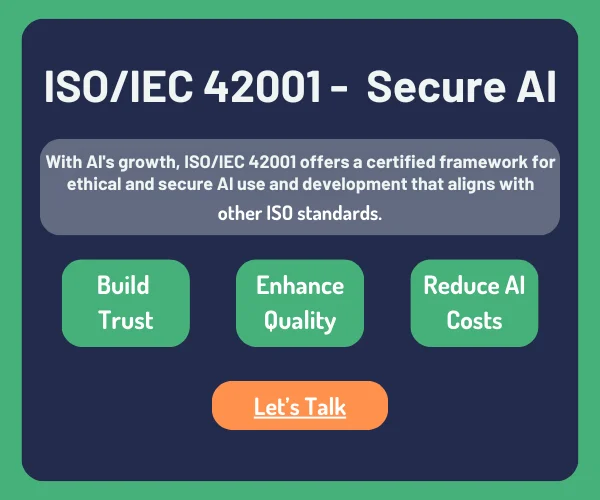
ISO 42001 is the first international standard dedicated to Artificial Intelligence Management Systems (AIMS). It establishes a structured approach to govern AI ethically, transparently, and responsibly.
Key aspects of ISO/IEC 42001 include:
- Ethical deployment of AI models
- Human oversight and explainability
- Bias detection and fairness controls
- Data privacy and AI lifecycle monitoring
- Alignment with global AI regulations such as the EU AI Act
This standard is particularly relevant for organizations that develop, deploy, or rely on AI in regulated industries such as healthcare, finance, or government services.
What is ISO/IEC 27001?
ISO 27001 is a widely recognized Information Security Management System (ISMS) standard. It provides a framework to protect the confidentiality, integrity, and availability of information through comprehensive security controls.
Key elements of ISO/IEC 27001 include:
- Risk assessment and mitigation for data and information assets
- Access control and identity management
- Security incident management
- Secure data storage and transmission
- Compliance with legal, regulatory, and contractual requirements
ISO 27001 forms the foundation for secure organizational practices, ensuring that the data feeding AI systems is protected from breaches or unauthorized access.
How ISO/IEC 42001 and ISO/IEC 27001 Complement Each Other
While ISO/IEC 42001 focuses on ethical AI governance and ISO/IEC 27001 ensures data security, together they provide a comprehensive AI management framewor
1.Ethical AI Meets Data Security
ISO/IEC 42001 ensures AI models operate fairly, transparently, and with human oversight, while ISO/IEC 27001 secures the data powering these models. The combination guarantees that AI systems are both trustworthy and secure.
Integrated Risk Management
ISO/IEC 27001 addresses risks related to information security, whereas ISO/IEC 42001 tackles AI-specific risks, such as bias, explainability, and model drift. Aligning these standards ensures organizations cover all critical risk areas.
Streamlined Compliance
Mapping ISO/IEC 42001 controls onto existing ISO/IEC 27001 frameworks reduces duplication and simplifies compliance, enabling organizations to meet regulatory requirements more efficiently.
Increased Stakeholder Confidence
By integrating AI governance and data security, organizations demonstrate their commitment to ethical AI deployment and robust information protection, reinforcing trust with clients, regulators, and partners.
Benefits of Aligning ISO/IEC 42001 and ISO/IEC 27001
- Comprehensive Governance: Combines ethical AI management with secure information handling.
- Efficient Compliance: Reduces overlapping audits and streamlines processes.
- Enhanced Credibility: Demonstrates accountability to stakeholders across all dimensions of AI use.
- Business Growth & Market Differentiation: Few organizations certify against both standards early—doing so signals innovation, maturity, and leadership in AI governance and security.
- Accelerated Contract Wins: Opens opportunities with governments and large enterprises that demand trustworthy AI practices and robust security postures.
- Customer Confidence: Demonstrates a proactive approach to AI safety and data protection, easing concerns about opaque (“black-box”) AI risks.
- Facilitated AI Adoption: Streamlines the rollout of AI-driven products and services by assuring stakeholders of robust, integrated controls.
- Scalable Global Operations: A shared ISO framework simplifies expansion into markets with strict AI and security requirements.
Steps to Integrate ISO/IEC 42001 and ISO/IEC 27001
-
- Define Governance Roles – Appoint AI risk officers, compliance leads, and data security officers.
- Conduct a Gap Assessment – Identify areas where AI governance or data security controls are lacking.
- Develop Integrated Policies – Combine AI ethics, bias mitigation, data privacy, and security protocols.
- Implement Continuous Monitoring – Monitor AI models for accuracy and fairness while ensuring secure handling of sensitive data.
Conclusion
ISO/IEC 42001 and ISO/IEC 27001 address different but equally critical aspects of AI deployment. ISO/IEC 42001 ensures AI is ethical, transparent, and accountable, while ISO/IEC 27001 safeguards the data that powers AI systems. Together, they create a holistic governance framework that mitigates risks, builds stakeholder trust, and prepares organizations for global compliance requirements.
At Consilium Labs, we conduct audits and provide guidance to help organizations align ISO/IEC 42001 and ISO/IEC 27001, ensuring AI systems are secure, responsible, and capable of driving sustainable innovation.
FAQs About ISO 27001 Auditors and Audits
What does an ISO 27001 auditor do?
An ISO 27001 auditor assesses your organization’s compliance with the standard. They check your ISMS, documentation, and the effectiveness of your Annex A controls to determine if you meet certification requirements.
How long does an ISO 27001 audit take?
The audit process can vary depending on the size and complexity of your business, but typically the full process, including both stages, can take a few weeks.
What happens if we fail the audit?
If you fail the audit, your auditor will provide a report highlighting areas of noncompliance. You’ll have time to address these issues and schedule a follow-up audit.
FAQs About Consilium Labs
Who is Consilium Labs and how do they help with ISO 27001 certification?
At Consilium Labs, we put our clients first by simplifying the entire ISO 27001 certification process. By offering audits for ISO 27001, we ensure a smooth and efficient experience by narrowing down the audit scope. As an accredited Certification Body, we handle the complexities, giving you peace of mind while we help you achieve ISO 27001 compliance. This way, your team can concentrate on more pressing concerns while we manage the details of your audit and compliance needs.
Can Consilium Labs help us with compliance beyond ISO 27001?
Absolutely! Consilium Labs supports various standards within the ISO 27000 family, including ISO 27701, ISO 27017, and ISO 27018, all aimed at strengthening your organization’s information security management systems (ISMS). We also offer audits for frameworks like ISO 42001, SOC 2, Penetration Testing, and MS SSPA Services, tailored to fit your unique business needs.
Related Articles


Let's get in touch
Start your audit now. Achieving cybersecurity audit can be complex. We have made it our mission to simplify the process, giving you access to the professional expertise you need to prepare your company for the future. Get in touch with us today!

Lorem ipsum dolor sit amet, consectetur adipiscing elit. Ut elit tellus, luctus nec ullamcorper mattis, pulvinar dapibus leo.