In this article
How to Master Continuous Compliance in 2026 and Beyond
- Shaheer Tariq
Introduction
Continuous compliance is becoming a governance expectation for modern enterprises. Traditional compliance models still revolve around concentrated evidence collection, periodic review cycles, and last-minute audit activity. That model is under pressure. Organizations are increasingly expected to maintain current evidence, monitor control performance, and report material exceptions throughout the year rather than reconstructing records near a formal assessment window.
For enterprise leadership, the issue is larger than efficiency. Continuous compliance is becoming part of governance discipline. NIS2 broadens cybersecurity expectations across more sectors in the EU for entities within its scope, while the HIPAA Security Rule continues to require administrative, physical, and technical safeguards for ePHI in regulated healthcare environments. Those pressures reinforce the same operational question: can the organization demonstrate that controls, evidence, and oversight remain current between formal assessments?
What is continuous compliance?
Continuous compliance is the maintenance of current evidence, monitoring, and oversight across the operating environment rather than relying only on periodic checks. NIST defines information security continuous monitoring as maintaining ongoing awareness of information security, vulnerabilities, and threats to support risk management decisions, with assessment frequency set according to risk. That definition matters because “continuous” does not mean constant activity everywhere. It means defined, risk-based monitoring and reporting that remain active across the year.
In enterprise environments, this often includes identity and access evidence, configuration records, vulnerability data, supplier review records, logging status, policy attestations, incident records, and workforce records being maintained through ordinary business and technical workflows rather than reconstructed near an audit window. Splunk’s article captures that operational shift, especially the movement away from seasonal evidence scrambles and toward embedded monitoring.
Which six components define continuous compliance?
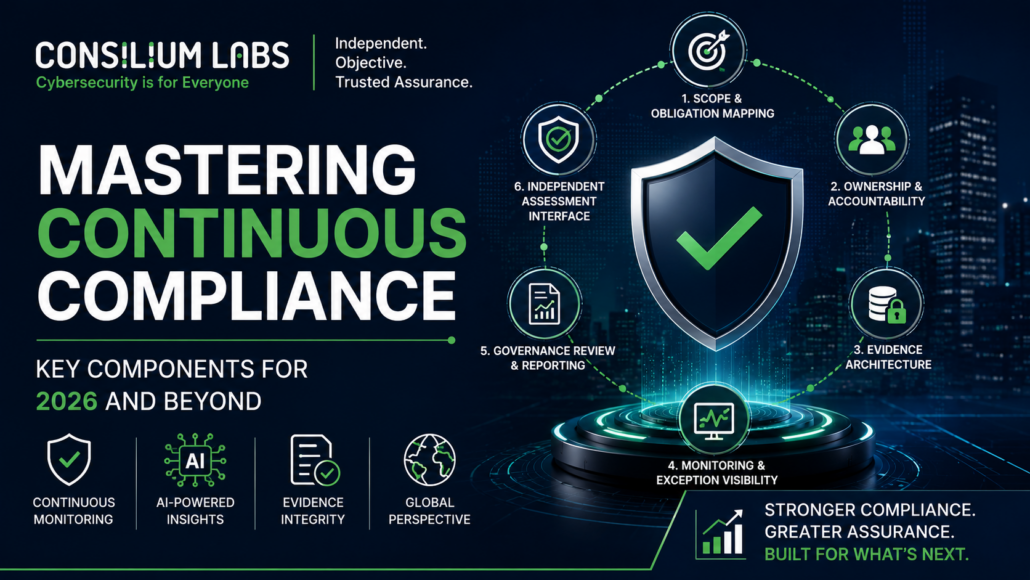
A defensible continuous compliance model usually rests on six connected components.
1. Scope definition and obligation mapping
Continuous compliance begins with knowing what applies, where it applies, and which assets, business units, products, jurisdictions, and suppliers are in scope. Without scope discipline, organizations often gather excessive low-value evidence while missing key obligations. NIST’s continuous monitoring work centers on visibility into organizational assets, controls, threats, and vulnerabilities precisely because monitoring without scope becomes noisy and weak.
2. Ownership and accountability
Every major obligation, control domain, and evidence stream needs a named owner. Enterprise governance sources from NIST emphasize that risk information must be aggregated and reported across levels so leaders can evaluate exposure and make decisions with current information. Ownership is what makes that possible in practice.
3. Evidence architecture
Organizations need defined evidence sources, retention logic, naming conventions, and review cadence. Evidence loses value when it is scattered across ticketing tools, spreadsheets, HR systems, cloud consoles, and inboxes with no consistent structure. Continuous compliance depends on whether records remain coherent under later independent review, not merely whether they exist. This is one of the clearest gaps between reactive compliance activity and a mature operating model.
4. Monitoring and exception visibility
Monitoring is the operational core. NIST’s glossary definition and SP 800-137 materials tie continuous monitoring directly to ongoing awareness and risk-based decision-making. In practice, that means organizations need visibility into control failures, stale evidence, critical configuration drift, unresolved supplier reviews, material access changes, and recurring nonconformities. Without exception visibility, compliance becomes archival rather than operational.
5. Governance review and reporting cadence
Monitoring alone is not governance. NIST IR 8286C states that monitoring and reporting at multiple hierarchical levels are necessary to maintain situational awareness regarding changes to the risk landscape and outcomes. That point is especially important for boards and executive teams: if reporting does not reach leadership in a structured cadence, continuous compliance remains technically active but organizationally weak.
6. Independent assessment interface
Continuous compliance is an internal operating condition. Independent assessment is a separate activity that evaluates evidence against defined criteria documenting areas of conformity, nonconformity, and assessment results through formal audit and assessment activity. Those roles should stay distinct. A strong internal model can reduce reconstruction effort and make scope clearer, but it does not replace independent evaluation. That distinction is important for any organization seeking independent assessment, because readiness and independent evaluation serve different purposes.
Where does AI fit into continuous compliance?
AI can contribute to continuous compliance when it is used as an analytical layer over structured evidence, risk signals, and operational records. NIST’s AI Risk Management Framework describes risk management as continuous and organized around govern, map, measure, and manage functions across the AI lifecycle. That model is useful here because it frames AI as part of governance and measurement, not as a substitute for control ownership or formal assurance.
In enterprise compliance environments, AI can be useful for evidence classification, anomaly detection across large record sets, summarization of control artifacts, issue clustering, and prioritization of exception patterns. It may also assist in identifying stale records, duplicate evidence, or incomplete mappings across large control libraries. But AI does not remove the need for governance decisions, review cadence, or independent assessment. NIST’s AI RMF supports this view by placing governance, mapping, measurement, and management at the core of AI risk management across the AI lifecycle.
Which frameworks shape continuous compliance expectations?
There is no single universal continuous compliance framework, but several authoritative frameworks shape how enterprises structure it.
NIST SP 800-137 remains foundational for continuous monitoring strategy, including visibility into assets, threats, vulnerabilities, and security control effectiveness. NIST IR 8286C connects monitoring and reporting to enterprise risk governance. NIS2 expands cybersecurity obligations across a broader range of sectors in the EU. HIPAA continues to define safeguard obligations in regulated healthcare. For AI-enabled environments, the NIST AI RMF provides a governance-centered model for managing AI-related risks across the lifecycle.
For large enterprises, the practical lesson is simple: continuous compliance is rarely about one framework in isolation. It is about maintaining a current evidence environment that can withstand scrutiny across security, privacy, resilience, supplier oversight, and AI governance contexts.
What obstacles most often weaken continuous compliance?
The first obstacle is fragmented records. The organization may have abundant evidence, but not in a form that leadership or independent assessors can evaluate coherently. The second obstacle is manual collection at enterprise scale. As environments grow, manual evidence handling becomes inconsistent and difficult to govern. The third obstacle is weak linkage between monitoring and executive reporting. NIST’s enterprise risk work makes clear that monitoring and reporting must feed situational awareness across levels, not remain isolated within specialist teams.
A fourth obstacle is supplier opacity. NIS2 explicitly raises the common level of ambition around cybersecurity and includes stronger expectations tied to supply chain security and vulnerability management at the member-state strategy level. In enterprise settings with outsourced infrastructure, cloud dependencies, and critical service providers, stale supplier records create visible assurance risk.
8 Questions to Ask When Evaluating Continuous Compliance
- Do we know which obligations apply across each product, region, and business unit?
- Is every major evidence stream assigned to a named owner?
- Are our most important records drawn from authoritative systems?
- How often are key control domains reviewed, and is that cadence risk-based?
- Can leadership see material exceptions and recurring nonconformities clearly?
- Do we maintain current visibility into critical suppliers and third parties?
- If an independent assessment began today, could we produce formal evidence without reconstruction?
- Are monitoring outputs linked to governance reporting rather than isolated dashboards?
These questions do not replace formal assessment, but they quickly reveal whether continuous compliance exists as an operating discipline or only as a documentation exercise.
FAQ
What is continuous compliance?
Continuous compliance is the maintenance of current evidence, monitoring, and oversight across the operating environment instead of relying only on periodic review cycles. NIST ties this concept to ongoing awareness sufficient for risk-based decisions.
Why does continuous compliance matter more in 2026?
It matters more because regulatory and contractual expectations continue to expand across cybersecurity, privacy, resilience, supplier oversight, and AI-enabled operations. NIS2 and HIPAA are examples of environments where ongoing safeguards and reporting remain material.
Does continuous compliance replace audits?
No. Continuous compliance is an internal operating model. Independent assessment remains a separate activity that evaluates evidence against defined criteria and documents findings formally.
Can AI be used in continuous compliance?
Yes, but within governance limits. NIST’s AI RMF positions AI risk management as continuous and governance-centered. AI may assist with classification, anomaly detection, summarization, and exception analysis, but it does not replace ownership, review, or independent assessment.
Which frameworks are most relevant?
NIST SP 800-137, NIST IR 8286C, NIS2, HIPAA, and the NIST AI RMF are all relevant depending on sector, geography, and operational model.
What does leadership need to see?
Leadership needs clear reporting on ownership, evidence currency, material exceptions, recurring nonconformities, supplier exposure, and risk concentration across the enterprise. NIST’s ERM materials explicitly connect monitoring and reporting to situational awareness at different organizational levels.
Final thought
Continuous compliance in 2026 is no longer just a tooling discussion. It is a governance question about whether the organization can maintain current evidence, defined ownership, monitored exceptions, and leadership visibility across changing environments.Industry discussions often frame continuous compliance as a more efficient alternative to periodic audit preparation. That view is directionally correct, but incomplete. That is directionally correct, but incomplete. The deeper issue is whether the organization can demonstrate that compliance exists as an observable operating condition.
Consilium Labs conducts independent assessments against applicable standards and frameworks, documenting conformities and nonconformities through formal audit and assessment activity. For organizations examining how their operating model appears under objective evaluation, that distinction matters.


Related Articles
Let's get in touch
Start your audit now. Achieving cybersecurity audit can be complex. We have made it our mission to simplify the process, giving you access to the professional expertise you need to prepare your company for the future. Get in touch with us today!