In this article
How to Prepare for ISO 42001 and Stronger AI Governance
- Sajjad Syed
Introduction
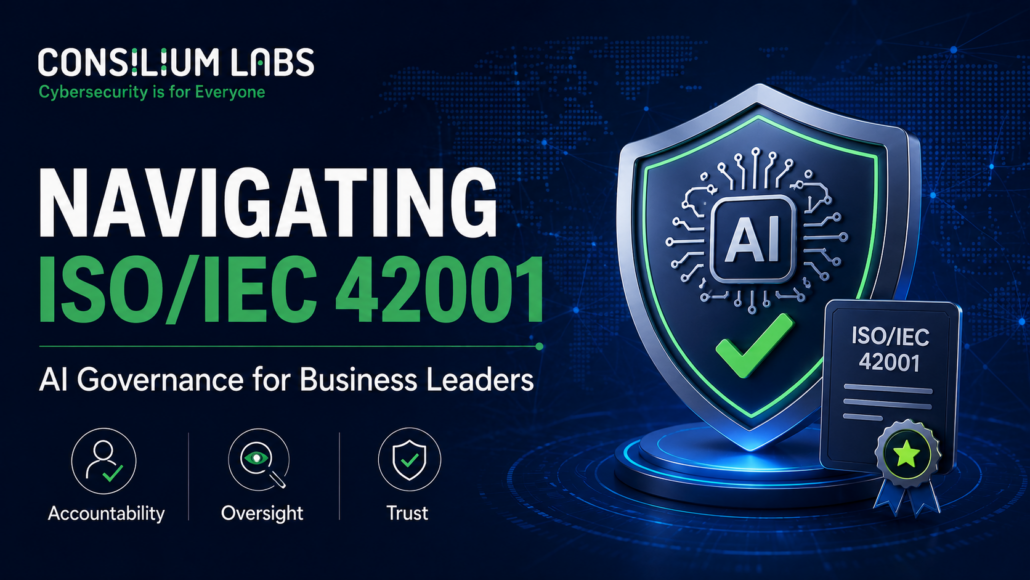
ISO 42001 for AI governance is becoming increasingly relevant as artificial intelligence moves from experimentation into core business operations. Organizations now use AI to analyze data, automate workflows, personalize customer experiences, detect fraud, evaluate risk, summarize records, and influence decisions that affect people, markets, and operations.
As AI adoption expands, business leaders are facing a new governance question:
How can an organization demonstrate that its AI systems are managed with accountability, transparency, and appropriate oversight?
ISO/IEC 42001 provides a structured answer.
The standard establishes requirements for an Artificial Intelligence Management System, commonly known as an AIMS. It gives organizations a formal framework for governing AI-related responsibilities, risks, processes, records, and oversight mechanisms.
For business leaders, ISO/IEC 42001 is important because it moves AI governance from a general policy discussion into a structured management system that can be independently assessed.
Understanding ISO 42001
ISO/IEC 42001 is designed for organizations that develop, provide, or use AI-based products, services, or systems. Its purpose is to establish a management-system structure for responsible AI governance.
The standard addresses issues that are now central to AI accountability, including:
- Organizational roles and responsibilities
- AI risk identification and evaluation
- Data quality and security considerations
- Transparency and explainability
- Human involvement in significant AI decisions
- Monitoring of AI systems over time
- Documentation and evidence traceability
ISO/IEC 42001 does not treat AI as a purely technical issue. It treats AI as an organizational governance matter.
That distinction is critical.
AI systems may be built by technical teams, but their effects can reach customers, regulators, boards, employees, suppliers, and the public. Business leaders therefore need to understand how AI decisions are owned, reviewed, documented, and evaluated.
The AI governance environment is becoming more demanding.
The EU AI Act has increased global attention on risk-based AI regulation. NIST’s AI Risk Management Framework has also shaped how organizations think about trustworthiness, risk, governance, and measurable AI oversight. At the same time, enterprise buyers and boards are asking more detailed questions about AI transparency, security, data protection, and accountability.
ISO/IEC 42001 fits into this environment by giving organizations a recognized framework for demonstrating that AI governance is structured and evidence-based.
This matters because AI risk is different from traditional technology risk.
AI systems can produce biased outputs, drift over time, become difficult to explain, depend on large or sensitive datasets, and generate outcomes that were not anticipated when the system was first deployed. These risks are not always visible through standard cybersecurity or software governance processes alone.
ISO/IEC 42001 helps organizations place AI risk within a formal management-system structure.
For business leaders, ISO/IEC 42001 should be viewed as a governance and accountability framework.
It raises important executive-level questions:
Who owns AI-related decisions?
Which AI systems fall within scope?
How are AI risks documented?
What records demonstrate oversight?
How is human involvement defined for significant decisions?
How are third-party AI systems evaluated?
How are AI-related changes recorded over time?
These questions matter because AI governance cannot depend on informal ownership or scattered documentation.
A mature AI Management System connects AI use cases, risk records, responsible roles, lifecycle controls, evidence, and leadership review. The result is a clearer operating picture of how AI is governed across the organization.
Consider a healthcare organization using AI to analyze patient information. The organization must demonstrate how AI use is governed, who is accountable for oversight, how data quality is evaluated, and how human review is incorporated into significant decisions.
Consider a financial institution using AI for fraud detection or risk scoring. The organization must be able to show how AI-related risks are identified, how model performance is monitored, and how records connect decisions to governance processes.
Consider a manufacturer using predictive systems to monitor equipment. The organization must understand where AI is used, how system changes are documented, and how operational risks are reviewed.
These scenarios differ by industry, but the governance themes are consistent: scope, accountability, risk evaluation, documentation, monitoring, and evidence.
Common Challenges in AI Governance
Organizations evaluating ISO/IEC 42001 certification often encounter recurring governance challenges, including:
- AI inventories that do not clearly identify all systems within scope
- Unclear ownership of AI-related decisions
- Fragmented documentation across technical and business teams
- Limited traceability between risks, records, and oversight activities
- Inconsistent evaluation of third-party AI tools
- Weak evidence of management-level review
- Unclear documentation of human involvement in significant decisions
These challenges are not limited to one sector. They reflect the broader complexity of governing AI responsibly.
The strongest AI governance environments are not defined by isolated policies. They are defined by disciplined records, clear accountability, consistent review, and traceable decision-making.
During an ISO/IEC 42001 certification assessment, auditors evaluate whether the defined AIMS conforms to the applicable requirements of the standard.
This may include review of:
- The defined scope of the AIMS
- AI governance roles and responsibilities
- Risk evaluation records
- Lifecycle documentation
- Evidence of monitoring and review
- Management oversight records
- Documentation of human involvement
- Records related to third-party AI systems
The outcome is a formal audit report documenting conformities and nonconformities.
This independent validation is important because AI governance increasingly requires more than internal claims. Organizations must be able to demonstrate how their AI systems are governed through objective, evidence-based assessment.
Consilium Labs conducts independent ISO/IEC 42001 assessments against applicable requirements.
Our role is to evaluate the defined Artificial Intelligence Management System objectively, review evidence within the agreed scope, and issue formal audit reports documenting conformities and nonconformities.
As AI governance becomes a higher priority for boards, regulators, and enterprise buyers, independent assessment will continue to play an important role in establishing trust.
AI is becoming embedded in the way organizations operate, compete, and make decisions.
That influence brings responsibility.
ISO/IEC 42001 gives business leaders a structured framework for governing AI systems through accountability, transparency, risk evaluation, documentation, and oversight.
For organizations adopting AI across products, services, or operations, the standard provides a recognized pathway for demonstrating responsible AI governance through independent assessment.
Ready to prove your competitive edge and scale with confidence?
 Schedule your ISO 42001 certification audit with Consilium Labs today.
FAQs About ISO 27001 Auditors and Audits
What does an ISO 27001 auditor do?
An ISO 27001 auditor assesses your organization’s compliance with the standard. They check your ISMS, documentation, and the effectiveness of your Annex A controls to determine if you meet certification requirements.
How long does an ISO 27001 audit take?
The audit process can vary depending on the size and complexity of your business, but typically the full process, including both stages, can take a few weeks.
What happens if we fail the audit?
If you fail the audit, your auditor will provide a report highlighting areas of noncompliance. You’ll have time to address these issues and schedule a follow-up audit.
FAQs About Consilium Labs
Who is Consilium Labs and how do they help with ISO 27001 certification?
At Consilium Labs, we put our clients first by simplifying the entire ISO 27001 certification process. By offering audits for ISO 27001, we ensure a smooth and efficient experience by narrowing down the audit scope. As an accredited Certification Body, we handle the complexities, giving you peace of mind while we help you achieve ISO 27001 compliance. This way, your team can concentrate on more pressing concerns while we manage the details of your audit and compliance needs.
Can Consilium Labs help us with compliance beyond ISO 27001?
Absolutely! Consilium Labs supports various standards within the ISO 27000 family, including ISO 27701, ISO 27017, and ISO 27018, all aimed at strengthening your organization’s information security management systems (ISMS). We also offer audits for frameworks like ISO 42001, SOC 2, Penetration Testing, and MS SSPA Services, tailored to fit your unique business needs.
Related Articles


Let's get in touch
Start your audit now. Achieving cybersecurity audit can be complex. We have made it our mission to simplify the process, giving you access to the professional expertise you need to prepare your company for the future. Get in touch with us today!

