In this article
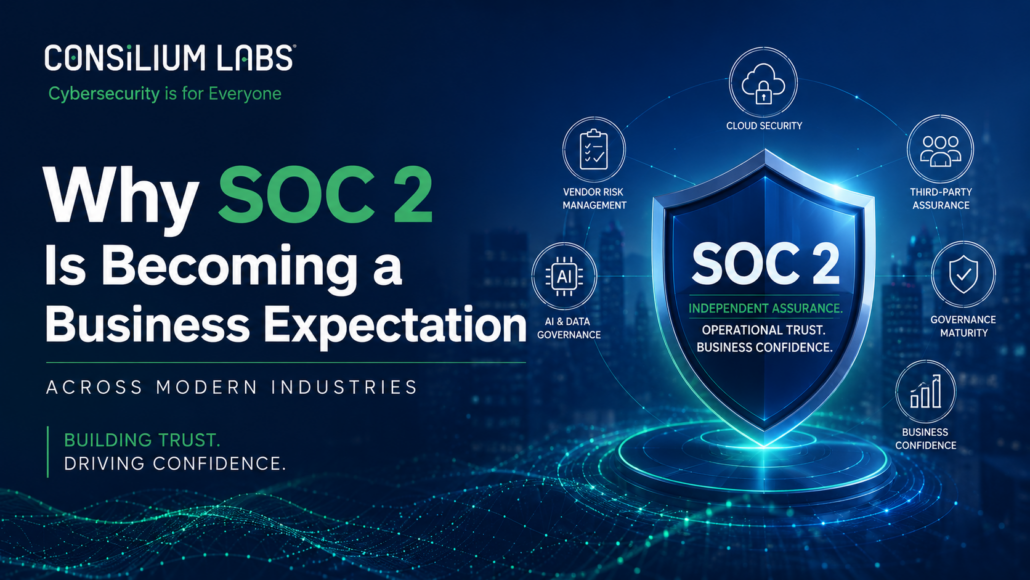
Why SOC 2 Audits Are Becoming a Business Expectation Across Modern Industries
- Jorge Sandoval
Introduction: Security Is No Longer a Department Issue
A major shift is happening across modern business environments.
Security, governance, and operational integrity are no longer viewed as isolated IT responsibilities. They are becoming business expectations tied directly to trust, procurement, partnerships, and organizational credibility.
This shift is one of the reasons SOC 2 audits continue to expand across industries. The AICPA & CIMA describes SOC offerings as assurance reports that give users information needed to assess risks connected to outsourced services, which is especially relevant as organizations rely more heavily on external platforms, vendors, and digital service providers.
Today, organizations across healthcare, AI, logistics, financial services, professional services, infrastructure, manufacturing, and digital platforms are increasingly pursuing SOC 2 examinations as part of broader governance and trust strategies.
The conversation is no longer only about whether SOC 2 applies to software providers. The larger question is how organizations demonstrate operational trust in an economy shaped by data, systems, and third-party relationships.
What Is the Difference Between SOC 2 Type I and SOC 2 Type II?
SOC 2 audit types are not interchangeable. Both SOC 2 Type I and SOC 2 Type II are assurance examinations, but they answer different questions for customers, procurement teams, vendor risk reviewers, and executive stakeholders.
For organizations comparing SOC 2 Type I vs Type II, the distinction comes down to timing, depth, and the level of evidence available for review.
SOC 2 Type I Definition
A SOC 2 Type I audit is a point-in-time examination that evaluates whether an organization’s controls are designed appropriately as of a specific date.
It answers the question:
Do the right controls exist within the defined system as of the report date?
A Type I report is often used by early-stage companies, SaaS providers entering enterprise discussions, and technology organizations that need an initial SOC 2 report for customer assurance. It provides a structured view of control design, but it does not evaluate whether those controls operated across a longer review window.
A SOC 2 Type I engagement is commonly completed within a shorter audit window than Type II because it focuses on control design at one date rather than control operation across months.
SOC 2 Type II Definition
A SOC 2 Type II audit is conducted over an observation period, commonly six to twelve months, and evaluates whether controls were operating effectively throughout that window.
It answers the question:
Were the controls followed and operating over time within the defined system?
The SOC 2 Type II observation period is one of the main reasons Type II reports carry greater weight in enterprise procurement and vendor risk review. Instead of evaluating control design only, Type II examines whether the organization’s controls operated across a defined period.
For many enterprise buyers, especially in SaaS, cloud infrastructure, healthcare technology, fintech, and regulated sectors, SOC 2 Type II is viewed as a stronger assurance outcome because it reflects control operation over time.
SOC 2 Type I vs Type II Comparison
Dimension | SOC 2 Type I | SOC 2 Type II |
Audit duration | Single point in time | Six- to twelve-month observation period |
What is tested | Design of controls | Design and operating effectiveness of controls |
Time to complete | Often four to eight weeks, depending on scope and evidence availability | Often six to eighteen months total, depending on the observation period, scope, evidence availability, and report cycle |
Cost | Lower upfront investment compared with Type II | Higher investment, reflecting broader scope and period-based procedures |
Market acceptance | Often accepted in early-stage customer assurance or SMB review cycles | More commonly requested by enterprise buyers, regulated customers, and vendor risk teams |
Best for | Companies new to SOC 2, early enterprise discussions, and organizations seeking an initial report | Established vendors, regulated industries, enterprise procurement, and government-related customer review |
Assurance depth | Evaluates control design at a specific date | Evaluates control operation across a defined period |
Customer expectation | Useful for initial trust discussions | Often preferred for deeper vendor risk review and enterprise assurance |
The SOC 2 audit cost comparison also reflects this distinction. Type I engagements are generally narrower because they examine a defined point in time. Type II engagements involve an observation period, broader evidence review, and procedures tied to operating effectiveness across time.
Organizations often search for a SOC 2 compliance timeline, but the more precise phrase is SOC 2 audit timeline. SOC 2 is not a certification; it is an examination that results in an independent report reviewed, signed, and issued by an independent CPA.
Which SOC 2 Audit Type Does Your Industry Require?
Different industries approach SOC 2 audit types with different expectations. The right direction depends on customer requirements, data sensitivity, procurement expectations, vendor risk review practices, and the nature of the systems within scope.
SaaS and Cloud Infrastructure
For SOC 2 for SaaS and cloud infrastructure companies, enterprise buyers commonly request SOC 2 Type II before approving higher-value contracts or critical vendor relationships.
SaaS platforms often manage customer data, user access, cloud systems, APIs, integrations, and business-critical workflows. Because of that, procurement and vendor risk teams frequently want a report that evaluates not only whether controls are designed, but whether they operated across a defined period.
For early customer conversations, SOC 2 Type I may provide an initial assurance signal. For broader enterprise acceptance, SOC 2 Type II is often the stronger expectation.
Healthcare and Health Technology
Healthcare and health technology organizations often face heightened review because they may process sensitive patient, operational, or business information.
SOC 2 Type II is commonly requested when healthcare technology providers interact with covered entities, business associates, digital health platforms, or health data environments. These stakeholders often want deeper evidence around security, confidentiality, availability, access control, monitoring, and vendor risk review.
SOC 2 Type I may be useful in early review cycles, but Type II is often expected when healthcare customers require greater confidence in control operation over time.
Financial Services and Fintech
Financial services and fintech organizations frequently operate in environments shaped by institutional review, vendor risk expectations, payment workflows, confidentiality obligations, and operational resilience requirements.
For fintech companies, SOC 2 Type II is often requested by banks, payment processors, institutional clients, and enterprise customers. In many cases, the selected Trust Services Criteria may include Security, Availability, and Confidentiality, depending on the system scope and customer expectations.
SOC 2 Type I may address an initial review need. SOC 2 Type II is often more relevant when financial services customers require evidence of control operation over a defined period.
Government Contractors
Government contractors and technology providers serving public-sector customers may encounter more formal security, procurement, and vendor evaluation processes.
SOC 2 Type II may be treated as a baseline assurance expectation in some procurement environments, especially when the organization provides cloud services, manages sensitive information, or delivers systems connected to public-sector operations.
SOC 2 does not replace FedRAMP, state-level requirements, or other applicable frameworks. However, a SOC 2 Type II report may be reviewed as part of a broader vendor risk and procurement evaluation process.
Early-Stage Startups
Early-stage startups may begin with SOC 2 Type I when they need an initial report for enterprise conversations.
A SOC 2 Type I startup pathway can provide a point-in-time view of control design while the organization moves toward a Type II observation period. This can be relevant for SaaS startups, AI companies, cloud platforms, and other technology-driven businesses entering larger customer discussions for the first time.
For startups, the decision is often practical: Type I can address initial customer assurance needs, while Type II provides a stronger period-based report once control operation has been evaluated over time.
SOC 2 Is Becoming Embedded in Procurement and Vendor Risk Reviews
One of the strongest trends shaping the market is the growing role of SOC 2 in procurement and vendor review workflows.
Enterprise customers increasingly expect independently evaluated information about security governance, access management, monitoring practices, and operational controls. Procurement teams are no longer satisfied with broad security claims alone. They want structured evidence that controls are designed and operating within defined environments.
This aligns with broader third-party risk expectations. NIST describes cybersecurity supply chain risk management as the process of identifying, assessing, and mitigating risks connected to the distributed and interconnected nature of ICT and operational technology supply chains.
As organizations become more interconnected through vendors, platforms, cloud environments, and data-sharing relationships, SOC 2 reports are becoming a recognized component of vendor assurance discussions.
AI and Data Governance Are Expanding SOC 2 Relevance
Artificial intelligence is changing how organizations process, analyze, and manage information. As AI adoption expands, organizations are facing greater scrutiny around data handling, access management, system reliability, and operational accountability.
SOC 2 is not an AI-specific framework. However, its Trust Services Criteria are relevant to many organizations operating AI-enabled or data-intensive environments because the criteria address security, availability, processing integrity, confidentiality, and privacy of systems and information.
For organizations hosting AI models, processing enterprise datasets, managing cloud-based environments, or providing AI-enabled services, SOC 2 can provide a recognized assurance mechanism for demonstrating structured operational controls.
This trend is especially important as AI systems become more embedded in business-critical workflows. Stakeholders increasingly want confidence that advanced technology environments are governed with discipline and clear accountability.
SOC 2 Is Evolving Into a Governance Signal
Another major trend shaping the industry is the growing perception of SOC 2 as more than a technical security exercise.
Organizations increasingly recognize that SOC 2 examinations communicate broader operational qualities such as governance maturity, executive oversight, accountability, and organizational structure. This matters because trust decisions today are no longer made only by technical teams.
Procurement leaders, legal teams, investors, compliance functions, and executive stakeholders all evaluate organizational credibility through different lenses. SOC 2 gives these audiences a recognized format for reviewing how an organization manages controls within a defined system.
NIST Cybersecurity Framework 2.0 also reinforces the importance of governance by placing the “Govern” function at the center of cybersecurity risk management, including cybersecurity supply chain risk and executive-level oversight.
SOC 2 fits into this broader market shift by giving organizations a structured way to communicate operational trust and governance discipline.
Cloud Environments Are Increasing the Need for Recognized Assurance
Cloud adoption has also increased the relevance of structured assurance mechanisms.
Modern organizations frequently rely on distributed systems, shared environments, remote access, and multiple service providers. These operating models create new expectations around accountability, visibility, and control ownership.
The Cloud Security Alliance’s Cloud Controls Matrix is one example of how the industry has developed structured control frameworks for cloud environments. CSA describes the CCM as a cybersecurity control framework for cloud computing, organized across control domains covering key aspects of cloud technology.
AICPA & CIMA has also published mapping between the Trust Services Criteria and CSA’s Cloud Controls Matrix, demonstrating the relationship between SOC 2 criteria and cloud security control expectations.
This reinforces a broader point: SOC 2 is increasingly relevant in cloud-driven environments where organizations must demonstrate governance over systems, data, access, and operational reliability.
SOC 2 Across Modern Industries
SOC 2 is now relevant across a broad range of sectors.
Organizations in healthcare, financial services, retail, logistics, manufacturing, AI, data analytics, infrastructure services, and professional services are increasingly pursuing SOC 2 examinations because stakeholders expect stronger evidence of operational maturity and security governance.
The common factor is not industry type alone. The common factor is trust.
Organizations that manage sensitive information, operational systems, customer data, or interconnected digital services increasingly require recognized mechanisms for demonstrating that controls are structured, monitored, and governed responsibly.
SOC 2 continues to gain visibility because it provides a widely recognized structure for communicating that trust.
The Importance of Structured Audit Leadership
As SOC 2 expectations grow, organizations are also recognizing the importance of disciplined audit execution and clear engagement coordination.
A SOC 2 engagement should feel structured, transparent, and professionally managed from beginning to end. Organizations navigating complex operational environments benefit from clear scope definition, consistent communication, and disciplined audit coordination throughout the engagement lifecycle.
At Consilium Labs, SOC 2 audit engagements are conducted through a modern methodology focused on independent evaluation, evidence-based assessment, and structured execution. The approach emphasizes clarity, transparency, and professional audit management aligned with organizational governance objectives.
The SOC 2 report itself is reviewed, signed, and issued by an independent CPA.
Our role is to conduct and coordinate the audit engagement in a manner that reinforces governance clarity and recognized assurance outcomes.
Frequently Asked Questions About SOC 2 Audits
How long does a SOC 2 Type II audit take?
A SOC 2 Type II audit requires an observation period of at least six months, during which controls must be actively operating within the defined system scope. The full SOC 2 audit timeline often ranges from nine to eighteen months, depending on scope, evidence availability, internal review cycles, auditor scheduling, and the independent CPA report cycle.
Can a startup get SOC 2 Type I instead of Type II?
Yes. SOC 2 Type I is a common starting point for early-stage companies that need to demonstrate security posture to enterprise prospects. Many organizations complete a Type I report first, then begin the Type II observation period as the next stage in their SOC 2 audit timeline.
What industries require SOC 2 Type II?
Healthcare, financial services, SaaS, cloud infrastructure, and government contracting are among the sectors where SOC 2 Type II is most commonly requested. Enterprise procurement teams in these industries may expect a current Type II report when vendors manage sensitive data, critical systems, or regulated customer environments.
What is the difference between SOC 2 Type I and SOC 2 Type II?
SOC 2 Type I evaluates whether controls are properly designed at a single point in time. SOC 2 Type II evaluates whether those controls operated effectively over a six- to twelve-month observation period. For SOC 2 vendor risk review, Type II generally provides deeper evidence because it examines control operation over time.
How much does a SOC 2 audit cost?
SOC 2 audit cost varies based on scope, system complexity, Trust Services Criteria selected, organization size, auditor procedures, and report type. As a general market estimate, SOC 2 Type I audits may range from $10,000 to $30,000, while SOC 2 Type II audits may range from $30,000 to $100,000 or more for larger organizations. Additional technology and internal resource costs may apply.
Do I need SOC 2 to sell to enterprise customers?
In many cases, enterprise security reviews request a SOC 2 report as part of procurement or vendor risk evaluation. Without at least a SOC 2 Type I report, mid-market and enterprise opportunities may encounter delays during security review. SOC 2 enterprise requirements vary by customer, industry, data sensitivity, and system criticality.
Conclusion: Trust Is Becoming Continuous
The market is moving toward continuous trust expectations.
Organizations are no longer evaluated only on the products or services they provide. Increasingly, they are evaluated on how consistently, transparently, and responsibly they operate.
This is one of the key reasons SOC 2 continues to expand across industries and operational environments. It provides a recognized framework for demonstrating governance maturity, operational discipline, and structured security oversight in a world where trust must be continuously reinforced.
Organizations that approach SOC 2 strategically are often better positioned to communicate credibility, accountability, and operational consistency to customers, partners, investors, and other critical stakeholders.
If your organization is evaluating SOC 2 as part of its broader governance strategy, Consilium Labs conducts independent, standards-based audit engagements for modern organizations across industries.
Related Articles


Let's get in touch
Start your audit now. Achieving cybersecurity audit can be complex. We have made it our mission to simplify the process, giving you access to the professional expertise you need to prepare your company for the future. Get in touch with us today!