In this article
Compliance Maturity Model in 2026: Measuring Governance, Risk, and Evidence
- Consilium Labs
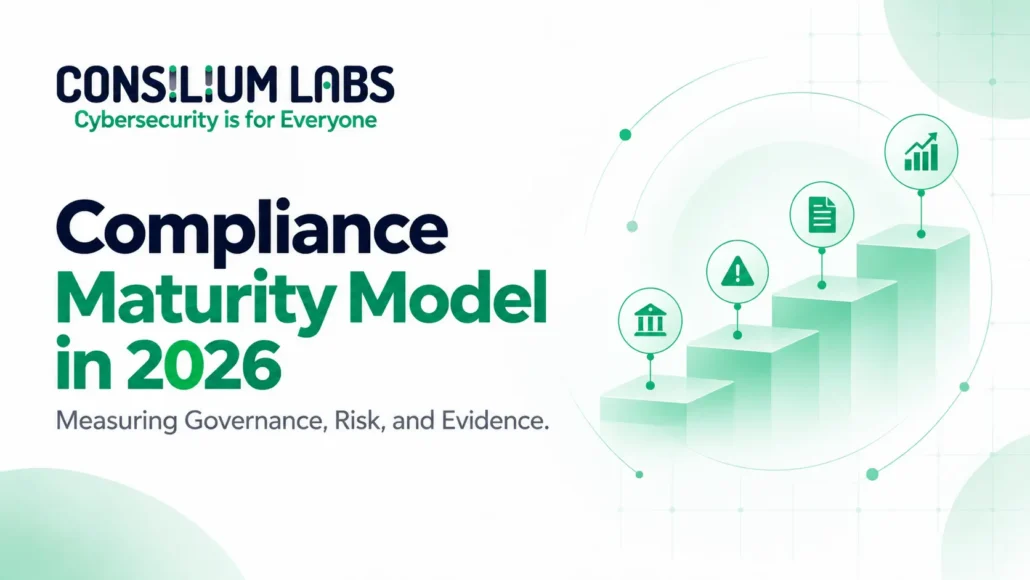
As compliance requirements become increasingly interconnected, a compliance maturity model gives SaaS and technology-driven organizations a structured way to examine governance, risk, evidence, and oversight.
For SaaS companies and technology-driven enterprises, regulatory obligations now intersect with cybersecurity, privacy, artificial intelligence, cloud infrastructure, third-party relationships, customer requirements, and corporate governance. What may once have been managed through individual policies or periodic reviews increasingly requires a more structured view of how compliance operates across the organization.
The scale of that challenge is visible in recent research. PwC’s Global Compliance Survey 2025 found that 85% of respondents believe compliance requirements have become more complex over the previous three years. Nearly 90% also reported an increase in the breadth of their compliance responsibilities. Yet only 7% characterized their organizations as leading in compliance maturity.
That gap makes the compliance maturity model increasingly relevant in 2026.
A maturity model does more than ask whether a policy exists or whether a control has been performed. It examines how consistently governance, risk management, accountability, evidence, technology, and monitoring operate together.
For leadership teams, the result can be a clearer picture of how compliance actually functions across the enterprise—not simply how it is described on paper.
What Is a Compliance Maturity Model?
A compliance maturity model is a structured method for evaluating how developed and consistently applied an organization’s compliance processes are across defined areas.
It typically considers elements such as governance, accountability, risk management, policies, control activities, evidence, monitoring, technology, and executive oversight.
The distinction between maturity and traditional compliance measurement is important.
A conventional compliance question might ask:
Has this requirement been satisfied?
A maturity question goes further:
How consistently does the organization manage this requirement across people, processes, systems, evidence, and oversight?
Consider two SaaS companies with similar security policies.
One relies heavily on individual employees to remember review cycles, collect evidence from separate systems, and coordinate compliance activities through spreadsheets and email.
The other has formally assigned ownership, documented processes, consistent evidence retention, defined monitoring, centralized records, and management-level reporting.
Both organizations may have the same policy.
Their compliance maturity, however, can be significantly different.
A maturity model provides a way to examine that difference.
What Are the Five Levels of a Compliance Maturity Model?
There is no single universal maturity scale for every compliance environment. Models vary by framework, industry, and purpose.
A common five-stage structure can nevertheless provide a useful conceptual reference.
Level 1: Ad Hoc
Compliance activities are largely event-driven and dependent on individual knowledge.
Policies or procedures may exist in some areas, but execution varies. Evidence can be fragmented, ownership may not always be formally assigned, and similar requirements may be handled differently between teams.
At this level, leadership may know that compliance activities occur without having a consistent enterprise view of how they occur.
Level 2: Repeatable
Certain compliance activities have become recurring and recognizable.
Templates, review schedules, established responsibilities, recurring meetings, or common procedures may exist. However, different departments can still execute the same process differently.
Manual activity remains significant, and institutional knowledge continues to play an important role.
Level 3: Defined
Compliance processes become formally documented and more consistently applied.
Responsibilities are assigned. Procedures are established. Policies follow defined governance cycles. Control activities can be mapped to accountable owners, and evidence is retained according to documented processes.
At this level, the organization becomes less dependent on individual memory and informal practices.
Level 4: Measured
The organization can evaluate compliance activity through defined indicators and documented evidence.
Leadership may have visibility into metrics related to control execution, policy reviews, access governance, incidents, third parties, exceptions, risk assessments, and other relevant activities.
The key distinction is measurement: management can evaluate patterns rather than relying exclusively on individual confirmations.
Level 5: Integrated
Compliance operates as part of the wider governance and risk environment.
Responsibilities, technology, evidence, monitoring, risk information, and executive oversight are connected rather than managed as isolated functions.
This does not mean every process must become fully automated or that Level 5 must be the objective for every organization.
The appropriate maturity level depends on regulatory exposure, organizational complexity, customer requirements, contractual obligations, technology dependencies, and risk.
Why Does Compliance Maturity Matter More in 2026?
The compliance environment now extends well beyond traditional regulatory administration.
Technology is increasingly central to governance decisions. PwC identified cybersecurity and data protection and privacy among the leading compliance priorities in its 2025 global study.
Artificial intelligence is accelerating that shift.
The International Compliance Association’s 2025 global GRC survey found that 51.3% of respondents ranked advances in AI and technology as the largest expected driver of governance, risk, and compliance change during the next five years. Yet only 1.6% reported that AI had been fully integrated into GRC processes.
Regulatory developments have made the issue even more immediate. On August 2, 2026, significant provisions and enforcement mechanisms under the European Union AI Act became applicable, including transparency requirements for certain AI systems.
For technology companies operating across jurisdictions, these developments create a fundamental management question:
Can the organization demonstrate how its compliance processes operate through objective evidence?
A compliance maturity model can make that question easier to examine across several interconnected dimensions.
Governance
Are responsibilities clearly established, documented, and understood?
Risk Management
Are regulatory, cybersecurity, privacy, AI, vendor, and operational risks considered within defined processes?
Evidence
Can the organization demonstrate that required activities actually occurred?
Technology
Are compliance activities connected to the systems and data on which the organization depends?
Monitoring
Does management have reliable information about recurring activities, exceptions, risk indicators, and control performance?
Maturity becomes meaningful when these elements can be evaluated together.
How Can an Organization Assess Its Compliance Maturity?
A credible maturity assessment begins with scope.
Trying to assign one maturity score to an entire enterprise can conceal important differences between departments, systems, or regulatory domains.
A SaaS organization, for example, may have highly structured identity and access management while relying on comparatively fragmented processes for AI inventory management or third-party governance.
The assessment should therefore begin by identifying what is being examined.
That may include cybersecurity governance, privacy management, AI governance, third-party risk, enterprise compliance, a business unit, or processes connected to a specific framework.
From there, the organization can evaluate several dimensions.
Examine Governance and Ownership
Determine whether accountability is formally assigned.
Policies, risks, controls, evidence, exceptions, monitoring activities, and management decisions should have identifiable ownership.
Compare Documentation With Actual Operations
Documentation is only one part of maturity.
The more important question is whether documented policies and procedures reflect how activities actually operate.
Differences between written processes and observed execution can materially affect maturity conclusions.
Examine Objective Evidence
Evidence provides visibility into whether processes are occurring consistently.
Depending on the scope, evidence may include access reviews, risk records, system configurations, policy approvals, training records, vendor evaluations, incident records, management reviews, monitoring results, or other documented activities.
Evaluate Measurement
Organizations at higher maturity levels generally have greater visibility into patterns.
Management may be able to examine recurring exceptions, overdue activities, control execution trends, incident patterns, vendor issues, policy review cycles, or other defined indicators.
Consider Technology Dependencies
Automation alone does not establish maturity.
Technology must operate within defined governance structures, with appropriate ownership, records, controls, and oversight.
This is increasingly important where AI is incorporated into security, compliance, data processing, customer interaction, or decision-making environments.
8 Questions to Ask When Assessing Compliance Maturity
A useful maturity discussion can begin with eight questions:
- Are compliance responsibilities formally assigned to accountable roles?
- Do documented policies and procedures reflect actual operating practices?
- Can recurring control activities be demonstrated through retained evidence?
- Are similar requirements handled consistently across departments, locations, and systems?
- Does management receive defined information about compliance risk and control performance?
- Are third-party risks incorporated into established governance processes?
- Are cybersecurity, privacy, cloud, data, and AI risks considered within the wider compliance environment?
- Can monitoring and review activities be demonstrated through objective records?
These questions are not a substitute for a formal audit or independent assessment.
They are a way to determine whether the organization’s compliance environment appears fragmented, repeatable, defined, measurable, or integrated.
A Practical SaaS Compliance Maturity Scenario
Consider a growing B2B SaaS provider serving enterprise customers.
At an earlier maturity stage, security questionnaires may be handled separately by different employees. Evidence may reside across ticketing systems, shared drives, cloud platforms, spreadsheets, and email. Policy ownership may be understood internally without always being formally documented.
As processes become more defined, responsibility becomes clearer.
Control owners are documented. Policies follow established review cycles. Evidence retention becomes more consistent. Risk records follow defined processes. Vendor information is organized within an established governance structure.
At a measured stage, management can examine patterns across areas such as access reviews, control execution, incidents, risk treatment activity, vendor evaluation, and policy governance.
The distinction is not simply the number of controls in place.
It is the consistency, traceability, accountability, and quality of evidence surrounding those controls.
AI Governance Creates a New Maturity Test
AI provides another clear example of why maturity matters.
An organization may already use generative AI applications, embedded AI features, internally developed models, or third-party AI services.
At an early maturity stage, individual teams may adopt these technologies independently, with limited centralized visibility.
A more structured environment may include defined ownership, AI system inventories, documented risk classifications, relevant policies, retained records, defined approval processes, and governance mechanisms connected to existing enterprise risk structures.
In 2026, this distinction carries greater significance as AI regulation and standards continue to evolve.
ISO/IEC 42001 provides requirements for an artificial intelligence management system, while the EU AI Act has introduced regulatory obligations affecting certain providers and deployers of AI systems.
For technology-driven organizations, AI governance is therefore becoming part of the broader compliance maturity conversation rather than a separate technical issue.
Compliance Maturity Is Not the Same as Conformity
One of the most important distinctions in any compliance maturity discussion is the difference between maturity and conformity.
A maturity model evaluates how developed or consistently applied organizational processes appear across selected dimensions.
A standards-based audit or independent assessment examines whether defined criteria have been satisfied within an established scope.
Those are different questions.
An organization can operate sophisticated governance processes and still have nonconformities against particular requirements.
Similarly, conformity with selected requirements does not automatically establish that every compliance process across the enterprise operates at a high maturity level.
This is why maturity scores should not be treated as substitutes for independent validation.
Self-assessment can provide internal perspective.
Independent assessment provides objective evaluation against defined criteria.
From Maturity Models to Evidence-Based Assurance
The most useful compliance maturity models in 2026 are unlikely to be those that simply place an organization somewhere on a five-level diagram.
The greater value comes from understanding the evidence behind the rating.
For SaaS and technology-driven organizations, that means examining how governance, risk, controls, technology, third parties, evidence, and monitoring connect across the enterprise.
A mature environment should be demonstrable.
Policies should connect to processes. Processes should connect to accountable roles. Controls should connect to evidence. Evidence should connect to monitoring. Monitoring should provide management with a defensible view of how the organization operates.
That is where the compliance maturity model becomes more than a conceptual framework.
It becomes a structured lens for understanding whether compliance exists primarily as documentation—or as a consistently operating governance system.
Independent Assessment with Consilium Labs
Consilium Labs conducts independent, evidence-based assessments and standards-based audits across cybersecurity, information security, privacy, AI governance, cloud assurance, and related frameworks.
Consilium Labs also operates as an A2LA-accredited inspection body under ISO/IEC 17020:2012 for defined inspection activities, with accreditation centered on competence, impartiality, and consistent operation.
Our role is objective evaluation against defined criteria, grounded in documented evidence and formal findings.
Frequently Asked Questions
What is a compliance maturity model?
A compliance maturity model is a structured framework for evaluating how consistently an organization manages governance, risk, controls, evidence, accountability, technology, and monitoring. It commonly uses defined stages to distinguish fragmented processes from more structured and measurable environments.
What are the five levels of compliance maturity?
A commonly used structure includes Ad Hoc, Repeatable, Defined, Measured, and Integrated. Terminology varies among maturity models, and the appropriate interpretation should reflect the organization, scope, regulatory environment, and purpose of the evaluation.
How is compliance maturity measured?
Compliance maturity can be examined through documented evidence relating to governance, accountability, policies, risk management, control execution, evidence retention, metrics, monitoring, technology, third parties, and management oversight.
Does a high compliance maturity rating prove conformity?
No. Compliance maturity and conformity represent different forms of evaluation. A maturity rating describes the development and consistency of processes, while conformity must be determined against applicable requirements within a defined scope.
Can different departments have different compliance maturity levels?
Yes. Different functions, locations, systems, and compliance domains can operate at different levels. Examining those variations can provide more meaningful information than relying exclusively on a single organization-wide maturity rating.
Why does AI matter to compliance maturity in 2026?
AI increasingly intersects with privacy, cybersecurity, data governance, transparency, third-party risk, and regulatory obligations. Organizations using or providing AI systems may therefore need to consider AI governance within their broader compliance environment.
What is the role of an independent assessment?
An independent assessment provides objective evaluation against defined criteria using documented evidence. It is distinct from an internal maturity exercise because conclusions are reached through an independent, standards-based evaluation process.
About Consilium Labs
Consilium Labs is an independent conformity assessment organization conducting standards-based audits and evidence-based assessments across cybersecurity, information security, privacy, artificial intelligence, cloud assurance, and related frameworks.
For defined inspection activities, Consilium Labs operates as an A2LA-accredited inspection body under ISO/IEC 17020:2012. Its approach is grounded in independence, impartiality, objective evidence, documented findings, and credible assurance outcomes.

Related Articles
Let's get in touch
Start your audit now. Achieving cybersecurity audit can be complex. We have made it our mission to simplify the process, giving you access to the professional expertise you need to prepare your company for the future. Get in touch with us today!