In this article
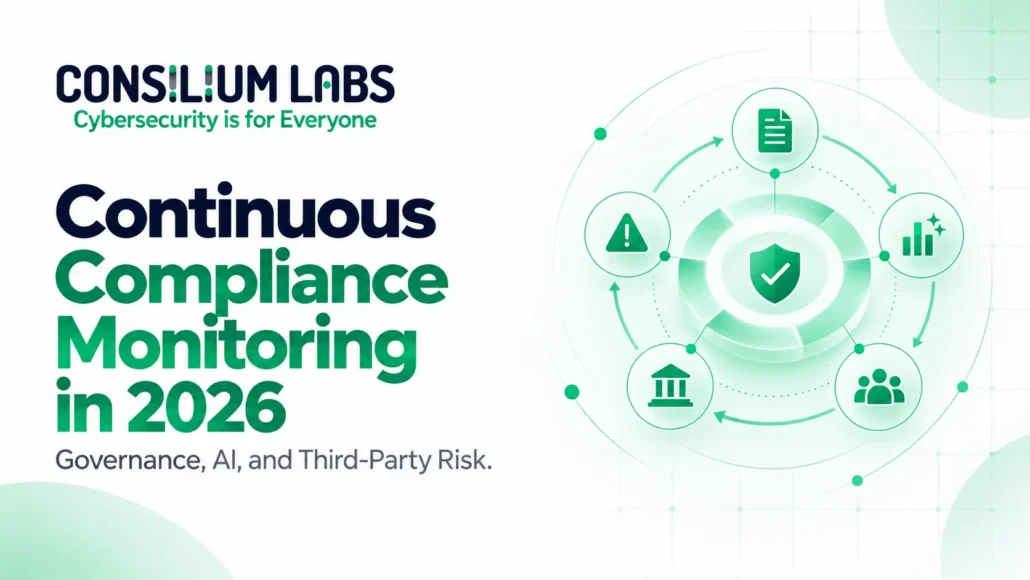
Continuous Compliance Monitoring in 2026: Governance, AI, and Third-Party Risk
- Consilium Labs
Continuous compliance monitoring is becoming increasingly important for SaaS companies and technology-driven enterprises operating across cloud infrastructure, AI systems, third-party ecosystems, and expanding regulatory requirements.
Cloud environments change throughout the day. User privileges are granted and revoked. New software dependencies enter production. Vendors change infrastructure. AI systems process new categories of data. Regulatory obligations evolve across jurisdictions.
Against that backdrop, continuous compliance monitoring gives enterprises a structured way to observe relevant controls, systems, evidence, and third-party dependencies between formal assessment cycles.
Its purpose is not to declare that an organization is continuously compliant. Rather, it gives management more timely visibility into whether defined compliance-related conditions continue to operate as expected.
That distinction matters in 2026.
The Digital Operational Resilience Act has applied to covered EU financial entities since January 17, 2025 and places significant emphasis on ICT risk and external technology providers. The EU AI Act also reached another important stage on August 2, 2026, when Article 50 transparency obligations became applicable for relevant AI systems. In healthcare, the U.S. Department of Health and Human Services has proposed significant changes to the HIPAA Security Rule, including more explicit requirements involving asset inventories, risk analysis, technical safeguards, testing, and recurring evaluation.
The regulatory landscape is reinforcing a broader reality: organizations increasingly need reliable evidence of what is happening across their environments, not simply a policy describing what should happen.
What Is Continuous Compliance Monitoring?
Continuous compliance monitoring is the recurring or automated observation of systems, controls, events, configurations, records, and other evidence relevant to defined compliance requirements.
Traditional compliance activity may examine evidence at scheduled intervals. Continuous monitoring shortens the distance between those observations.
For example, an organization might monitor whether privileged accounts remain appropriately configured, whether required logging remains enabled, whether cloud resources deviate from approved configuration conditions, or whether critical suppliers experience events that could alter the organization’s risk exposure.
The key word is monitoring.
A monitoring platform can observe a condition, generate an alert, retain a record, or identify an exception. It does not independently determine conformity merely because a dashboard remains green.
Formal conformity conclusions require defined criteria, appropriate evidence, established scope, and an applicable assessment process.
This is one of the most important distinctions for enterprise leaders evaluating continuous compliance technologies.
Why Is Continuous Compliance Monitoring Becoming More Important in 2026?
Enterprise technology environments have become too dynamic for compliance visibility to depend entirely on occasional manual snapshots.
A SaaS provider may deploy infrastructure changes several times within a short period. A financial institution may rely on dozens or hundreds of ICT providers. A healthcare technology organization may process regulated data through cloud platforms, analytics services, AI tools, and external service providers.
Each dependency can change the evidence landscape.
Continuous compliance monitoring provides a mechanism for observing selected conditions between formal evaluations.
That can create several operational advantages.
Better visibility into control conditions
Automated monitoring can identify when a defined technical condition changes.
Instead of discovering months later that logging was disabled, an identity configuration changed, or a cloud asset fell outside a defined configuration baseline, the organization can receive an earlier signal.
The signal itself is not an audit conclusion. It is evidence that a condition deserves examination.
More consistent evidence collection
Modern compliance environments can produce evidence across identity platforms, cloud systems, endpoint tools, ticketing platforms, code repositories, security systems, vendor records, and governance platforms.
Continuous monitoring can make those records more traceable by associating technical events with defined control objectives and timestamps.
Greater visibility across complex enterprises
For larger organizations, a single compliance status can conceal significant variation.
One business unit may maintain strong monitoring coverage while another depends heavily on manual records. One cloud environment may be well instrumented while another contains limited telemetry.
Continuous monitoring can expose those differences more clearly.
What Role Does AI Play in Continuous Compliance Monitoring?
AI is increasingly being incorporated into compliance technology to analyze large volumes of evidence, classify alerts, correlate events, summarize changes, and prioritize potentially significant conditions.
This is where AI compliance solutions can become useful—but also where disciplined governance becomes essential.
An AI-generated finding should not automatically become a compliance conclusion.
Organizations need to understand what data the system evaluated, how the finding was produced, whether the underlying evidence is reliable, and whether a qualified person reviewed the result where appropriate.
AI can increase analytical capacity. It can also introduce model error, incomplete context, false positives, and opaque reasoning.
For that reason, the strongest continuous monitoring environments treat AI as part of the evidence and monitoring architecture—not as a substitute for accountable human judgment.
This becomes particularly relevant as AI regulation develops. The European Commission confirmed that Article 50 transparency obligations under the EU AI Act became applicable on August 2, 2026 for relevant providers and deployers.
For enterprises operating AI systems, monitoring may therefore increasingly extend beyond conventional cybersecurity controls into AI inventories, data flows, transparency requirements, human oversight, model governance, and external AI providers.
Why Must Third-Party Risk Management Be Part of Continuous Monitoring?
Modern organizations rarely control their entire technology environment directly.
Cloud providers, payment processors, software vendors, data processors, AI services, managed infrastructure providers, analytics platforms, and other external organizations can all affect compliance exposure.
This makes third-party risk management a core part of the continuous monitoring discussion.
DORA illustrates the issue clearly. The regulation recognizes that financial organizations are deeply dependent on ICT providers and establishes requirements around digital operational resilience and ICT third-party risk.
The same principle extends well beyond finance.
A SaaS organization may depend on a cloud hosting provider.
A healthcare platform may depend on external organizations that process protected health information.
An AI company may rely on third-party models, data services, infrastructure, or model-monitoring tools.
Continuous third-party monitoring can examine relevant changes such as security events, service dependencies, control attestations, contract status, exposure indicators, material infrastructure changes, or other defined risk signals.
But dashboards alone have limitations.
For material suppliers, organizations may require evidence beyond questionnaires and automated external signals.
This is where an independent second-party audit can provide another layer of assurance.
Consilium Labs conducts customer-directed second-party audits that independently evaluate a supplier or service provider against an agreed scope and criteria and produce a formal assessment report.
What Does Continuous Compliance Monitoring Look Like Across Different Industries?
The technology may be similar, but the evidence that matters differs by industry.
Healthcare and Health Technology
Healthcare environments place significant emphasis on the confidentiality, integrity, and availability of electronic protected health information.
Continuous monitoring may therefore examine access activity, identity configurations, encryption conditions, asset inventories, logging, network changes, external providers, and security events.
The proposed HIPAA Security Rule changes illustrate the direction of regulatory expectations. HHS has proposed more explicit requirements involving technology asset inventories, network maps, risk analysis, vulnerability scanning, penetration testing, technical controls, and recurring evaluation. These remain proposed requirements rather than final rules at the time of writing.
Fintech and Financial Services
For financial organizations, monitoring increasingly intersects with operational resilience.
DORA places ICT risk, incident management, resilience testing, and external technology dependencies within a unified regulatory structure for covered organizations.
A financial enterprise may therefore monitor technology dependencies, critical provider status, privileged access, security events, service availability, configuration conditions, and records connected to external ICT relationships.
B2B SaaS and Cloud Platforms
SaaS organizations operate in highly dynamic technical environments.
Relevant monitoring may include identity and access conditions, cloud configuration, logging, deployment activity, security events, software dependencies, data-processing environments, and vendor relationships.
For organizations addressing multiple frameworks, one technical control may also produce evidence relevant to more than one assessment.
This makes evidence architecture increasingly important.
AI-Enabled Organizations
AI adds another monitoring layer.
Organizations may need visibility into AI inventories, model use, data sources, external AI providers, access, model changes, human oversight, risk classifications, and transparency requirements.
Where ISO/IEC 42001 is relevant, management-system monitoring and measurement also become part of the evidence examined during certification audits. Consilium Labs’ certification process includes evaluation of monitoring and measurement activities within applicable audit scopes.
What Features Matter in Modern Continuous Compliance Monitoring?
The strongest systems do more than generate alerts.
They establish a traceable relationship between requirement, control, signal, evidence, ownership, and decision.
Modern platforms may include automated control observation, centralized evidence records, cloud configuration monitoring, identity monitoring, third-party risk signals, regulatory mapping, dashboards, alert workflows, and AI-assisted analysis.
The technology is only part of the equation.
A technically sophisticated platform can still produce limited assurance if controls are poorly defined, evidence sources are incomplete, alert thresholds are unreliable, or accountability is unclear.
This is why monitoring architecture should always be evaluated alongside governance.
10 Questions to Assess Your Compliance Monitoring System
Decision-makers can use these questions to examine whether their current monitoring environment produces meaningful evidence:
- Are monitoring rules mapped to clearly defined requirements or control objectives?
- Can each significant signal be traced to its original evidence source?
- Does the system retain timestamps and sufficient historical evidence?
- Are critical alerts assigned to accountable roles?
- Does monitoring cover identity, cloud infrastructure, data, systems, and other relevant technology domains?
- Are critical third parties monitored according to their level of access, data exposure, and operational importance?
- Are AI-generated observations validated before they are treated as compliance conclusions?
- Can the organization distinguish an automated exception from a formal audit finding or nonconformity?
- Does leadership have visibility into monitoring coverage, unresolved exceptions, evidence quality, and material third-party risk?
- Could an independent assessor trace significant conclusions back to objective evidence?
The tenth question may be the most revealing.
Continuous monitoring becomes substantially more meaningful when the evidence remains understandable and reproducible outside the monitoring platform itself.
Does Continuous Compliance Monitoring Replace an Audit?
No.
Continuous compliance monitoring and independent audits answer different questions.
Monitoring asks whether selected conditions continue to operate within defined parameters.
An independent audit or assessment asks whether objective evidence demonstrates conformity with specified criteria across an established scope.
A monitoring system may produce valuable audit evidence. It may show configuration history, event records, access activity, control execution, or other relevant information.
The independent evaluator must still determine whether that evidence is sufficient, appropriate, reliable, and relevant to the criteria being assessed.
For certification activities, the distinction is particularly important.
Consilium Labs conducts independent, standards-based certification audits under defined accreditation and certification requirements. Assessment conclusions remain grounded in objective evidence, applicable criteria, defined scope, and independent decision processes.
Continuous Monitoring Is Ultimately an Evidence Question
The future of continuous compliance monitoring is not simply more dashboards.
It is better evidence.
For technology-focused enterprises in 2026, the most effective monitoring environments will increasingly connect:
Requirements → Controls → Technology → Evidence → Third Parties → Management Oversight → Independent Assurance
Automation can make evidence more observable.
AI can make large evidence sets more analyzable.
Third-party monitoring can expand visibility beyond organizational boundaries.
But credible assurance still depends on whether evidence can withstand objective evaluation.
That is the line enterprise leaders should keep clear.
Continuous monitoring belongs inside the organization’s governance environment.
Independent assessment provides the external evaluation of defined criteria.
Together, they represent different layers of a modern assurance architecture.
Independent Assessment with Consilium Labs
Consilium Labs conducts independent, evidence-based audits and assessments across information security, privacy, artificial intelligence, cloud assurance, cybersecurity, and supplier environments.
For defined inspection activities, Consilium Labs operates as an A2LA-accredited Inspection Body under ISO/IEC 17020:2012, with assessment activities grounded in competence, impartiality, consistent operation, and objective evidence.
For organizations seeking independent evaluation of supplier security and compliance posture, Consilium Labs also conducts second-party audits against clearly defined scopes and criteria.
Frequently Asked Questions
What is continuous compliance monitoring?
Continuous compliance monitoring is the recurring or automated observation of systems, controls, evidence, events, and other conditions relevant to defined compliance requirements. It provides more current visibility than relying exclusively on periodic reviews.
Does continuous compliance monitoring prove that an organization is compliant?
No. Monitoring can provide evidence about selected conditions, but conformity must be evaluated against applicable criteria and an established scope.
What is the difference between continuous monitoring and an independent audit?
Continuous monitoring is an internal operational capability. An independent audit evaluates objective evidence against specified requirements and produces formal conclusions according to the applicable assessment process.
How does AI affect continuous compliance monitoring?
AI can classify evidence, correlate signals, identify unusual conditions, and analyze large data sets. AI-generated observations still require appropriate governance, traceability, and validation.
Why is third-party risk management important to continuous monitoring?
External providers can affect security, privacy, operational resilience, regulatory exposure, and customer data. Monitoring material suppliers extends visibility beyond the organization’s direct technology environment.
Which industries benefit from continuous compliance monitoring?
The concept is especially relevant to highly regulated and technology-dependent environments, including SaaS, cloud services, healthcare, financial services, AI companies, and organizations managing complex supplier ecosystems.
Can continuous monitoring evidence be used during an audit?
Potentially. Logs, configuration records, monitoring reports, access records, system events, and similar materials may form part of audit evidence when they are relevant, reliable, traceable, and appropriate to the defined audit criteria.
About Consilium Labs
Consilium Labs is an independent conformity assessment organization conducting evidence-based audits and assessments across cybersecurity, information security, privacy, artificial intelligence, cloud assurance, and related standards and frameworks.
Its audit and assessment activities emphasize independence, impartiality, objective evidence, documented findings, and credible assurance outcomes.

Related Articles
Let's get in touch
Start your audit now. Achieving cybersecurity audit can be complex. We have made it our mission to simplify the process, giving you access to the professional expertise you need to prepare your company for the future. Get in touch with us today!