In this article
AI-Driven Audit Management Software in 2026: What Enterprises Should Evaluate
- Elad Motola
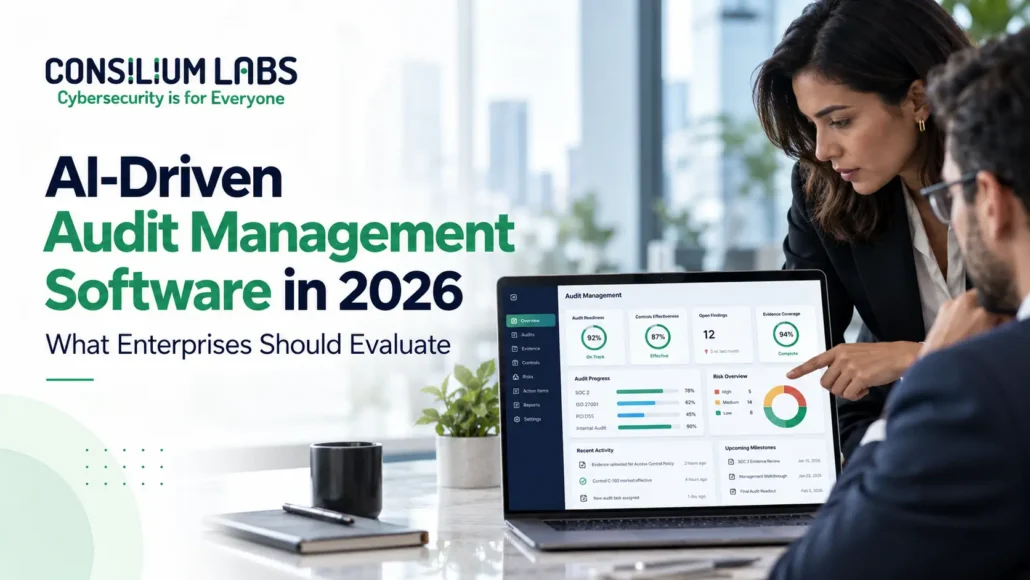
Enterprise audit and compliance programs are becoming more technology-dependent as organizations manage larger cloud environments, expanding third-party ecosystems, multiple assurance requirements, and growing volumes of technical evidence. In that environment, audit management software is evolving from a document repository into an operational system that can connect evidence sources, organize control information, monitor selected configurations, and give security and governance teams clearer visibility between formal assessment cycles.
Artificial intelligence is accelerating that evolution. AI-enabled platforms can help classify evidence, identify unusual patterns, reduce repetitive administrative work, and surface information that deserves human review. Yet automation does not change a fundamental principle of credible assurance: software can support internal governance and evidence workflows, but it does not replace management responsibility, professional judgment, or an independent evaluation against defined criteria.
For enterprises evaluating audit management software in 2026, the more useful question is therefore not simply which platform offers the most automation. It is whether the technology improves evidence quality, control visibility, accountability, and governance without creating false confidence about what automated monitoring can establish.
What Is Audit Management Software?
Audit management software is a digital platform used to organize activities such as audit planning, evidence management, control tracking, findings management, workflow coordination, and reporting. Depending on the platform and organizational environment, it may also connect with cloud infrastructure, identity systems, ticketing platforms, vulnerability management tools, human resources systems, and other enterprise applications.
The value of these systems comes largely from centralization. Organizations that rely on spreadsheets, email threads, screenshots, shared folders, and disconnected ticketing systems can struggle to establish a consistent record of what was reviewed, when evidence was collected, who owns a control, and whether a previously identified issue remains unresolved.
Modern platforms can reduce that fragmentation by creating structured relationships among controls, evidence, systems, owners, risks, and requirements.
However, the platform itself should not be confused with an independent audit or assurance outcome. Internal monitoring can strengthen an organization’s evidence environment, but formal engagements remain subject to the rules applicable to the specific activity.
ISO/IEC 27001, for example, is a management-system certification standard. SOC 2 is a CPA attestation examination based on applicable Trust Services Criteria. Regulatory obligations such as those associated with privacy or healthcare law follow different legal structures. Technology may help an organization manage information relevant to each environment, but those requirements and outcomes remain distinct.
How AI Is Changing Audit Management
AI can improve audit management by helping organizations process larger quantities of evidence and operational information more consistently. The strongest use cases generally involve augmenting human review rather than replacing it.
Automated Evidence Collection and Classification
Evidence collection remains one of the most resource-intensive parts of many enterprise governance programs. Security teams may need to gather access records, system configurations, policy approvals, tickets, vulnerability information, change records, and other artifacts from numerous systems.
Integrated platforms can automate portions of this process by retrieving information from connected systems and associating that information with defined controls or requirements.
AI may add another layer by helping classify documents, organize evidence, identify potentially missing information, or prioritize records for human review.
The result is not automatic proof of conformity. It is a more structured evidence environment that can reduce repetitive administrative work and improve traceability.
More Continuous Control Visibility
Traditional evidence collection often occurs around scheduled reviews. That creates the possibility that meaningful changes between review periods may not be identified quickly.
Modern platforms can monitor selected configurations and control signals more frequently. Examples may include privileged access changes, multi-factor authentication settings, unresolved vulnerabilities, cloud configuration changes, overdue access reviews, or other defined technical conditions.
This gives internal teams more timely visibility into potential control deviations.
That distinction matters: continuous monitoring is not the same as continuous compliance. Monitoring provides information. Management must still determine whether a condition represents a meaningful risk, what response is appropriate, and how the organization will address it.
Analytics That Support Risk Review
Some platforms use analytics or machine-learning capabilities to identify patterns, correlate information, or highlight activity that may warrant additional investigation.
For example, a system might detect an unusual access pattern, identify recurring evidence gaps across several control areas, or show that a particular technical control has generated repeated exceptions over time.
Used appropriately, these capabilities can help teams prioritize attention. They should not be treated as substitutes for professional judgment or as proof that a control environment is effective simply because an automated system reports a favorable status.
7 Capabilities Enterprises Should Evaluate
The strongest audit management platform is not necessarily the one with the largest feature list. Enterprises should evaluate whether a platform fits their technology environment, governance model, assurance obligations, and operating scale.
1. Automated Evidence Collection
The platform should be able to retrieve defined evidence securely from relevant enterprise systems where appropriate. This can reduce repetitive collection work while improving consistency and traceability.
Organizations should also examine how evidence is timestamped, retained, linked to source systems, and protected from unauthorized alteration.
2. Continuous Monitoring
Monitoring capabilities can help organizations identify changes in selected technical controls between formal review cycles.
The important question is not merely whether monitoring exists, but whether the monitored signals meaningfully reflect the organization’s actual control environment.
3. Cross-Framework Mapping
Many organizations manage requirements that overlap across multiple standards, assurance criteria, contractual obligations, and regulatory environments.
A platform may allow a single control or evidence source to be mapped to several applicable requirements. This can reduce duplication, provided the organization does not assume that similar requirements are identical or that satisfying one automatically satisfies another.
Each applicable framework still retains its own scope, criteria, evidence expectations, and outcome.
4. Risk and Exception Management
Strong platforms should make it possible to document risks, exceptions, ownership, status, and management decisions in a structured manner.
Where automated scoring is available, organizations should understand how that scoring is calculated and avoid treating a numerical score as a substitute for contextual risk analysis.
5. Findings and Action Tracking
Audit and assessment findings often involve multiple stakeholders, deadlines, evidence requests, and follow-up activities.
Integrations with enterprise task-management systems can help assign ownership and monitor management’s response to identified issues. The organization remains responsible for deciding how deficiencies will be addressed and for implementing its chosen response.
6. Executive-Level Reporting
Leadership teams need different information from security engineers.
Dashboards should therefore translate detailed operational information into meaningful governance indicators such as unresolved high-priority issues, evidence coverage, control exceptions, ownership gaps, recurring deficiencies, and trends over time.
Good reporting should increase clarity rather than compress complex assurance questions into a single misleading compliance score.
7. Integration and Evidence Traceability
The value of an automated platform depends heavily on the quality of its integrations.
Enterprises should examine whether the platform connects reliably with the systems that actually generate relevant evidence and whether users can trace information back to its source. Strong integrations can improve data continuity, reduce manual handling, and strengthen the audit trail.
The Critical Distinction: Technology, Management, and Independent Assurance
As audit technology becomes more capable, enterprises need to maintain a clear distinction among three different functions.
The Technology Layer
Audit and GRC platforms organize information, automate selected workflows, monitor defined signals, and support evidence collection.
They are tools.
The Management Layer
Management remains responsible for the organization’s systems, controls, governance decisions, risk acceptance, policies, corrective actions, and operating environment.
Technology can provide information to management, but it does not assume management responsibility.
The Independent Assurance Layer
Independent professionals evaluate evidence according to the standards, criteria, and professional requirements applicable to the specific engagement.
Different engagement types follow different professional structures and produce different outcomes. Technology can support evidence organization and review, but it does not determine an independent outcome, establish legal compliance, or replace the professional judgment required in a formal engagement.
For technology-focused enterprises, maintaining this separation is essential to credible governance.
Why Real-Time Risk Visibility Matters
Modern enterprise environments can change daily.
New cloud resources are deployed. User privileges change. Software dependencies are updated. Vendors gain access to systems. Security configurations drift. Employees join, transfer roles, and leave. New vulnerabilities emerge.
Formal audits and assessments evaluate defined scopes and periods in accordance with the requirements of the applicable engagement.
More continuous monitoring can help management identify material changes earlier by providing visibility into selected controls and evidence sources between formal engagements.
The business value lies in earlier awareness.
If a privileged-access configuration changes unexpectedly, for example, the organization may be able to investigate the condition before it persists for months. If evidence repeatedly disappears from a particular process, management can determine whether the underlying control is operating as intended. If the same exception appears across multiple review cycles, leadership gains stronger information for prioritizing risk.
This is where audit management technology becomes particularly valuable: not by guaranteeing conformity, but by improving the quality and timeliness of information available to the people responsible for governance.
Audit Management Software in Practice: Enterprise Use Cases
SaaS Company Managing Multiple Assurance Requirements
Challenge: A growing B2B SaaS company manages evidence relevant to ISO/IEC 27001, a SOC 2 examination, customer security reviews, and contractual security obligations. Teams repeatedly receive similar requests from different stakeholders.
How technology can help: A centralized platform can map relevant evidence to multiple internal requirement sets, maintain ownership information, and preserve a history of collected artifacts.
Business impact: Security teams spend less time locating duplicate information while leadership gains a clearer view of evidence ownership and recurring gaps. The individual assurance requirements and outcomes remain separate.
Cloud-Native Enterprise Managing Configuration Change
Challenge: A cloud environment changes frequently, creating the possibility that a previously reviewed configuration will later drift from the organization’s defined security expectations.
How technology can help: Integrations can monitor selected configuration signals and alert responsible teams when defined conditions change.
Business impact: Management receives earlier visibility into potential control deviations and can investigate whether corrective action is necessary.
Enterprise Reducing Manual Evidence Collection
Challenge: Security and engineering teams spend substantial time collecting screenshots, exporting logs, locating tickets, and assembling evidence from disconnected systems.
How technology can help: Automated integrations can retrieve selected evidence directly from connected systems and associate it with defined controls.
Business impact: Manual handling can be reduced while evidence traceability and consistency improve.
Organization Managing Third-Party Risk
Challenge: A growing vendor ecosystem creates hundreds of questionnaires, security reviews, contracts, exceptions, and follow-up actions that are difficult to manage through spreadsheets and email.
How technology can help: GRC platforms can centralize vendor records, questionnaires, evidence, risk information, assigned owners, and management follow-up.
Business impact: Leadership gains a more structured view of third-party risk and outstanding issues across the supply chain.
Enterprise Preparing for Independent Evaluation
Challenge: Evidence exists across the organization, but ownership, timestamps, supporting artifacts, and control relationships are fragmented.
How technology can help: A centralized platform can improve evidence organization and help management understand where documentation is incomplete or outdated.
Business impact: Internal teams can provide a more coherent evidence set when an independent evaluation begins, while the external evaluator remains responsible for determining what evidence is sufficient under the applicable engagement requirements.
How to Choose Audit Management Software
Enterprise buyers should begin with their operating model rather than the software demo.
A platform should support the organization’s existing infrastructure, governance responsibilities, evidence sources, and assurance obligations. A system that performs well in a small cloud-native environment may not necessarily fit a multinational enterprise with multiple business units, acquired technology environments, extensive third-party dependencies, and numerous assurance requirements.
Integration depth should receive particular attention. An impressive dashboard has limited value if the underlying evidence is incomplete, outdated, or disconnected from the systems that actually operate the controls.
Organizations should also examine data retention, security architecture, access controls, export capabilities, evidence traceability, workflow ownership, and the extent to which automated conclusions can be reviewed by humans.
Finally, enterprises should assess how the platform presents uncertainty. Mature governance systems should help teams investigate exceptions rather than simply turn complex control environments into green and red status indicators.
Frequently Asked Questions
What is the difference between traditional and AI-enabled audit management software?
Traditional platforms often focus heavily on documentation, task tracking, evidence storage, and scheduled workflows.
AI-enabled platforms may add capabilities such as document classification, anomaly detection, evidence categorization, pattern identification, or automated prioritization.
The specific functionality varies by product. Organizations should evaluate what the AI actually does, which data it uses, how conclusions are produced, and where human review remains necessary.
Can audit management software establish that an organization is compliant?
Not by itself.
Software can monitor selected controls, organize evidence, identify exceptions, and support internal governance activities. Whether an organization satisfies a particular standard, assurance criterion, contractual requirement, or regulatory obligation depends on the applicable requirements, defined scope, evidence, and decision-making authority involved.
Formal certification, attestation, inspection, and other assessment activities follow their respective professional frameworks.
Can AI replace human auditors?
AI can assist with large-volume data processing, classification, anomaly identification, and repetitive workflow activities, but human professional judgment remains essential.
Qualified professionals must interpret applicable criteria, understand context, evaluate evidence, investigate inconsistencies, and reach conclusions according to the rules of the relevant engagement.
Management, meanwhile, remains responsible for its business decisions and for designing, implementing, and operating its own controls.
Does continuous monitoring mean continuous compliance?
No.
Continuous monitoring can provide more frequent information about selected controls, configurations, or evidence sources. It may help identify changes earlier, but monitoring alone does not establish continuing conformity with every applicable requirement.
Can one piece of evidence support multiple frameworks?
Sometimes.
A single control or artifact may be relevant to requirements across multiple frameworks. Cross-mapping can reduce unnecessary duplication, but similar requirements should not automatically be treated as equivalent.
Each framework retains its own scope, terminology, criteria, and outcome.
How should enterprises evaluate AI claims made by software vendors?
Organizations should ask what data the AI uses, which functions are genuinely automated, how outputs are validated, whether users can review the underlying evidence, and what happens when the system is uncertain.
Claims involving prediction, automated scoring, or intelligent decision-making deserve particular scrutiny because their usefulness depends heavily on data quality, model design, configuration, and organizational context.
How does audit management software support an external audit or assessment?
The platform may help organize documentation, evidence, ownership information, historical records, and communication workflows.
However, the external evaluator remains responsible for determining what evidence is relevant and sufficient under the applicable engagement requirements. The platform does not determine the independent outcome.
Key Takeaways
Audit management software is becoming an increasingly important part of enterprise governance, particularly for organizations operating complex cloud environments and managing multiple assurance requirements.
AI can improve evidence handling, monitoring, classification, and analytical workflows, but organizations should evaluate those capabilities carefully rather than assume that automation equals assurance.
The strongest platforms improve visibility, traceability, accountability, and evidence organization.
They do not replace management responsibility.
They do not replace independent professional judgment.
And they do not collapse certification standards, CPA attestation criteria, regulatory obligations, and technical assessments into a single universal compliance outcome.
For SaaS and technology-driven enterprises, the goal should be a more reliable evidence environment: one in which management has clearer information, governance teams can identify meaningful changes earlier, and independent evaluators can assess defined evidence within the appropriate professional framework.
Independent Evaluation Requires More Than a Dashboard
Modern platforms can transform how organizations organize evidence and monitor their environments. Credible assurance, however, still depends on defined scope, objective evidence, competent evaluation, professional independence, and the requirements governing the specific engagement.
Consilium Labs conducts independent, standards-based engagements with an emphasis on objective evidence, clear communication, defined scope, and disciplined project coordination. Each engagement is handled according to the professional and accreditation framework applicable to that service.


Related Articles
Let's get in touch
Start your audit now. Achieving cybersecurity audit can be complex. We have made it our mission to simplify the process, giving you access to the professional expertise you need to prepare your company for the future. Get in touch with us today!