In this article
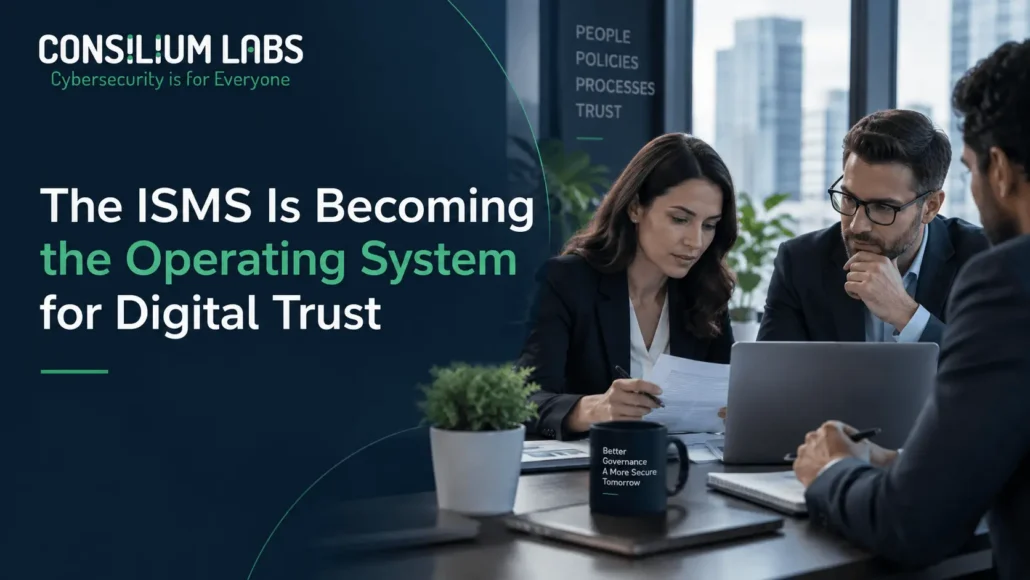
The ISMS is Becoming the Operating System for Digital Trust
- Hesper Andrew Flores
Introduction: Information Security Has Outgrown the IT Department
An Information Security Management System, or ISMS, was once discussed mainly among information security teams.
That has changed.
Today, boards want evidence of security oversight. Procurement teams examine how suppliers govern sensitive information. Regulators expect organizations to demonstrate accountability. Customers increasingly want objective proof that security practices extend beyond policy documents.
At the center of these expectations sits the ISMS.
ISO/IEC 27001 establishes internationally recognized requirements for creating, implementing, maintaining, and continually improving an Information Security Management System. But the significance of an ISMS goes beyond certification itself.
A mature ISMS creates a management structure around information security. It establishes who owns risk, how decisions are documented, how controls are selected, how evidence is maintained, and how leadership evaluates whether the system continues to operate as intended.
That is why the ISMS is increasingly becoming part of the infrastructure of digital trust.
What an ISMS Actually Does
The term Information Security Management System can sound abstract. In practice, it connects governance, risk, people, processes, technology, and evidence into one defined management system.
An effective ISMS answers fundamental questions such as:
Who is accountable for information security?
What information and systems fall within scope?
Which risks have been identified?
How are security controls selected in relation to those risks?
Who owns those controls?
What evidence demonstrates that those controls operate?
How does leadership review the effectiveness of the management system?
These questions matter because security failures frequently emerge from unclear ownership, inconsistent processes, fragmented evidence, or assumptions about how systems operate.
An ISMS creates structure around those issues.
A Mature ISMS Is More Than a Policy Library
One of the most persistent misconceptions around ISO/IEC 27001 is that the ISMS is primarily a documentation exercise.
Policies matter, but policies alone do not demonstrate conformity.
A formal ISMS connects documented requirements to actual operations. An access-control policy, for example, should correspond with evidence showing how access is authorized, reviewed, changed, and revoked. A supplier-security process should correspond with records showing how relevant third parties are governed. An incident-management process should be reflected in defined responsibilities and operational evidence.
The distinction is important.
A document explains what an organization says should happen.
Evidence demonstrates what actually happens.
Independent ISO/IEC 27001 assessment therefore examines far more than whether documents exist. Auditors evaluate objective evidence to determine whether the management system conforms to applicable requirements within the defined scope.
Why ISMS Scope Is Becoming More Important
The boundaries of modern organizations are becoming less obvious.
Information may move between cloud providers, contractors, internal teams, AI platforms, external processors, SaaS applications, development environments, and customers across multiple jurisdictions.
This makes ISMS scope one of the most consequential elements of ISO/IEC 27001.
Scope determines what the certification represents. It defines which organizational units, services, systems, locations, and information-processing activities are included within the management system. Any modifications to this scope require formal documentation and reassessment during surveillance audits to ensure ongoing conformity.
That means two organizations holding ISO/IEC 27001 certificates may have materially different certification scopes.
For buyers, boards, and procurement teams, the relevant question is therefore not simply:
“Are they ISO/IEC 27001 certified?”
It is also:
“What exactly does the certification cover?”
The distinction becomes especially important when organizations operate multiple platforms, business units, geographic locations, or outsourced environments.
Evidence Is Becoming the Language of Security Governance
The modern ISMS increasingly revolves around evidence.
Security claims must be traceable to records. Risk decisions must have documented ownership. Control activities must be demonstrable. Changes should leave an understandable history.
This shift becomes particularly important as organizations introduce more automation and AI into their operations.
AI can create new data flows, system dependencies, access pathways, and change-management considerations. ISO/IEC 27001 is not an AI management standard, but the ISMS remains highly relevant because AI-enabled environments still depend on information security fundamentals such as:
- asset management
- access control
- supplier relationships
- secure development
- logging and monitoring
- change management
- incident management
- information classification
- risk assessment
Organizations may adopt additional frameworks for AI-specific governance, but those frameworks do not eliminate the need for disciplined information security management.
Industry Use Cases: What an ISMS Looks Like in Practice
Healthcare and Digital Health
Healthcare environments contain some of the most sensitive information organizations can hold.
Patient records may move between hospitals, laboratories, insurers, digital health applications, billing services, cloud providers, and external specialists.
A healthcare ISMS can define how those information flows are governed under a structured risk-management system.
During an independent ISO/IEC 27001 audit, objective evidence may demonstrate how access responsibilities, supplier relationships, information classification, incident processes, and security governance operate within the defined scope.
For healthcare organizations, this provides stakeholders with recognized assurance that information security management has been independently evaluated.
Financial Services and Fintech
Financial institutions and fintech companies operate environments where trust and information integrity are fundamental.
Customer identities, payment information, transaction records, API connections, third-party processors, and digital platforms create complex information-security dependencies.
An ISMS provides a formal structure for managing those dependencies through risk-based governance.
For banks, payment companies, fintech platforms, and financial service providers, ISO/IEC 27001 certification can provide customers, partners, investors, and procurement teams with evidence that the management system has undergone independent assessment.
Manufacturing and Industrial Organizations
Manufacturing is increasingly dependent on digital infrastructure.
Intellectual property, engineering files, supplier portals, enterprise systems, production information, and connected operational environments all create information-security exposure.
An ISMS can bring those elements into a common governance structure.
This becomes particularly relevant where manufacturers operate within complex global supply chains and customers require evidence of security controls from critical suppliers.
ISO/IEC 27001 certification provides a recognized mechanism for demonstrating that the defined management system has been independently assessed.
Professional Services and Legal Firms
Professional service organizations often hold information that belongs to someone else.
Legal documents, financial records, intellectual property, client strategies, personnel data, and confidential communications may represent some of their most significant information assets.
The ISMS establishes how that information is governed through defined responsibilities, risk processes, control ownership, and evidence.
For legal, accounting, engineering, and other professional service organizations, ISO/IEC 27001 certification can therefore become an important third-party assurance signal during customer and supplier evaluations.
Cloud, SaaS, and AI-Enabled Organizations
Cloud-based companies operate in highly interconnected environments.
Customer information may interact with hosting providers, identity systems, development pipelines, API integrations, monitoring platforms, subcontractors, and AI services.
This complexity makes governance particularly important.
An ISMS establishes the management-system layer surrounding these environments. It defines how information-security risks are identified, how responsibilities are assigned, and how evidence is maintained.
For organizations embedding AI into products and internal operations, the ability to demonstrate these fundamentals is becoming increasingly relevant during enterprise procurement and external scrutiny.
Education and Research
Universities, schools, research institutions, and learning platforms manage a wide range of sensitive information.
Student records, research data, intellectual property, identity systems, funding information, and collaboration platforms may span multiple departments and third parties.
An ISMS provides a structured framework for determining scope, assigning responsibilities, evaluating risks, and maintaining security evidence across these environments.
For institutions participating in international research partnerships or handling sensitive research datasets, independent ISO/IEC 27001 certification can provide an additional assurance signal.
Why Independent Assessment Matters
An ISMS can be described internally as mature, structured, or effective.
Independent assessment tests those claims against objective evidence.
That distinction is central to ISO/IEC 27001 certification.
A standards-based audit evaluates the management system within its defined scope and records whether applicable requirements are satisfied. Findings are based on evidence, interviews, sampling, and documented audit activity.
Where nonconformities are identified, they are formally documented according to the certification process.
This separation between the organization operating the ISMS and the body evaluating it is fundamental to credible assurance.
Consilium Labs conducts independent, standards-based ISO/IEC 27001 audits based on objective evaluation and documented evidence. Our role is assessment: determining conformity against applicable requirements and issuing formal audit outputs.
New and Rising ISMS FAQs
1. Does every organization need the same type of ISMS?
No. ISO/IEC 27001 establishes requirements for the management system, but organizational context, information assets, risk exposure, technology environment, and scope differ significantly.
A hospital, manufacturing company, fintech platform, and university may all operate an ISMS while managing very different risks.
2. Does ISO/IEC 27001 require every Annex A control?
Not automatically.
ISO/IEC 27001 follows a risk-based approach. Organizations determine appropriate controls based on their information-security risks and document applicable control decisions through the required management-system processes.
The audit evaluates conformity against the requirements of the standard and the organization’s defined ISMS.
3. Can AI-generated evidence be used in an ISO/IEC 27001 audit?
The critical issue is not simply whether AI was involved in generating or organizing information.
Auditors require objective evidence that is reliable, attributable, relevant to the audit criteria, and connected to the activity being evaluated.
As AI becomes more common in compliance environments, evidence provenance and traceability are likely to receive greater attention.
4. Does ISO/IEC 27001 cover AI governance?
ISO/IEC 27001 is an information security management standard, not an AI management standard.
However, AI systems rely on information assets, access controls, infrastructure, third parties, change processes, and data flows. These may fall within an ISMS depending on scope and context.
AI-specific governance can also be addressed through standards such as ISO/IEC 42001. Because both standards utilize the harmonized structure (Annex SL), an organization’s existing ISMS can seamlessly integrate with a new AI Management System.
5. Does certification mean every system in the company is covered?
Not necessarily.
Certification applies to the defined ISMS scope. Organizations may certify an entire enterprise or a defined business unit, service, product environment, location, or combination of these.
Stakeholders evaluating certification should examine the scope statement rather than relying on the certificate title alone.
6. Can cloud environments be included within an ISMS?
Yes.
Cloud services, hosted infrastructure, SaaS applications, and outsourced providers can form part of an ISMS where they relate to the defined scope.
The relevant issue is how information-security risks and responsibilities associated with those services are governed.
7. What is becoming more important during ISMS audits?
Evidence quality and traceability remain central.
As organizations operate increasingly complex digital environments, auditors may need to understand relationships among systems, suppliers, control owners, risk decisions, and documented evidence.
Clear scope boundaries and defensible records become particularly important in those environments.
8. Does identifying a nonconformity mean the entire audit has failed?
No.
A nonconformity is a formal finding that a requirement has not been satisfied. Its treatment follows the applicable certification process and depends on its nature and classification.
The purpose of documenting a nonconformity is to record the audit conclusion accurately against the applicable criteria.
9. What should buyers examine when a vendor presents an ISO/IEC 27001 certificate?
The certificate itself is only part of the picture.
Buyers should understand the certification scope, the organization covered, the certification body, relevant dates, and whether the services or systems being evaluated fall within that scope.
This provides a more precise understanding of what the certification actually represents.
10. Will the ISMS become more important as organizations adopt AI?
Very likely.
AI increases dependency on data, digital infrastructure, third parties, access management, software development, and system monitoring.
While AI-specific management frameworks address additional concerns, the fundamental need to govern information securely remains.
That keeps the ISMS highly relevant in AI-enabled organizations.
Consilium Labs: Independent Assessment of the ISMS
A strong ISMS is not defined by the number of policies an organization possesses.
It is defined by whether governance, risk management, controls, accountability, and evidence operate together as a coherent management system.
Independent assessment provides the external perspective required to determine whether that system conforms to the applicable requirements of ISO/IEC 27001.
Consilium Labs conducts evidence-based, standards-driven ISO/IEC 27001 audits focused on objective evaluation, defined scope, documented findings, and recognized assurance outcomes.
For organizations operating in increasingly complex digital environments, that distinction matters.
Final Thought: The ISMS Is Becoming Business Infrastructure
Information security is no longer isolated from business governance.
It touches customers, suppliers, employees, regulators, technology, operations, and leadership.
The ISMS brings those relationships into one structured framework.
And as digital ecosystems become more interconnected, AI becomes more prevalent, and stakeholders demand stronger evidence of security governance, the role of the ISMS will continue to expand.
The question for modern organizations is therefore no longer simply whether they have security controls.
It is whether those controls operate inside a management system that can withstand independent scrutiny.


Related Articles
Let's get in touch
Start your audit now. Achieving cybersecurity audit can be complex. We have made it our mission to simplify the process, giving you access to the professional expertise you need to prepare your company for the future. Get in touch with us today!