In this article
Continuous Compliance Monitoring in 2026: Governance, AI, and Third-Party Risk
- Consilium Labs
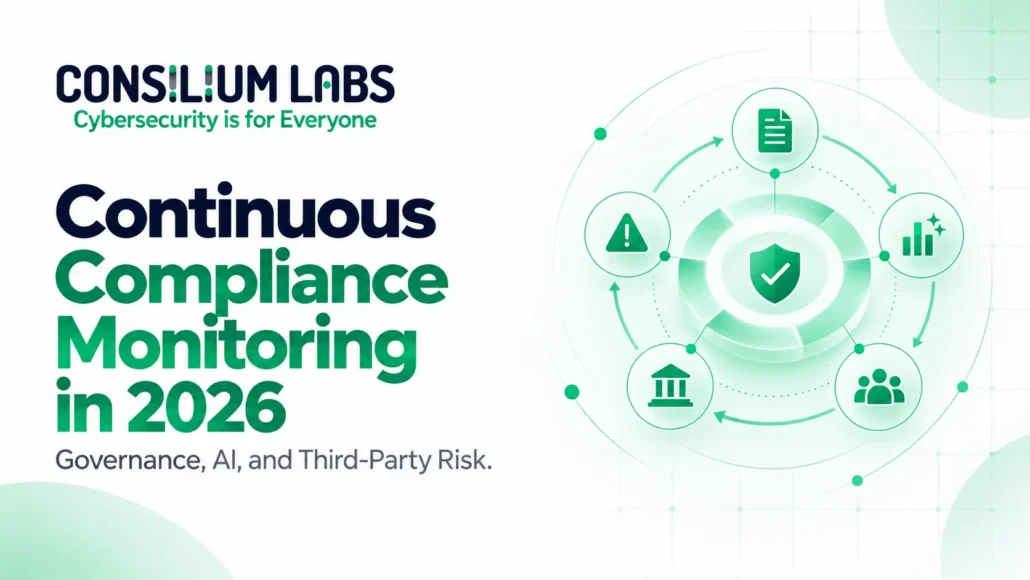
Continuous compliance monitoring is the recurring observation of systems, controls, evidence, configurations, and external dependencies against defined compliance requirements so organizations can see material changes between formal assessment cycles. For SaaS companies and technology-driven enterprises, this provides more current visibility across cloud infrastructure, AI systems, identity environments, third-party ecosystems, and other fast-changing areas.
The need for that visibility is increasingly practical. Cloud resources change throughout the day. User privileges are granted and revoked. New software dependencies enter production. Vendors alter infrastructure. AI systems process new categories of data. Regulatory requirements continue to evolve across jurisdictions. In this environment, a point-in-time review can provide important evidence, but it cannot by itself show what changed afterward.
Continuous monitoring narrows that visibility gap. Its purpose is not to declare that an organization is continuously conforming. Rather, it gives management more timely information about whether defined compliance-related conditions continue to operate as expected and whether evidence remains available for examination. The distinction between monitoring and formal conformity remains central to the article’s original position.
For covered EU financial entities, DORA has applied since January 17, 2025 and places significant emphasis on ICT risk and external technology providers. The EU AI Act also reached another stage on August 2, 2026, when Article 50 transparency obligations became applicable to relevant AI systems. In healthcare, proposed changes to the HIPAA Security Rule have placed additional attention on asset inventories, risk analysis, technical safeguards, testing, and recurring evaluation. These developments reinforce a broader trend: enterprises increasingly need reliable evidence of what is occurring across their technology environments, not simply policies describing what should occur.
Key Terms for Continuous Compliance Monitoring
Continuous control monitoring (CCM) is the recurring or automated observation of defined control conditions to identify changes, exceptions, or evidence that may require examination.
Compliance drift is the divergence between an established control, configuration, policy expectation, or governance requirement and the condition that exists later in the operating environment.
Control evidence is the documented or system-generated information used to demonstrate whether a defined activity, condition, or control operated within the relevant scope.
Evidence collection automation is the use of systems or integrations to capture records from relevant technology environments without depending entirely on manual collection.
Real-time compliance visibility describes management’s ability to observe selected compliance-related conditions with substantially less delay than traditional periodic review cycles.
Third-party attestation is documentation issued by an external organization or qualified party relating to defined controls, requirements, or assurance criteria. Its relevance depends on scope, period, issuer, and the evidence being relied upon.
Compliance posture management is the structured oversight of selected compliance-related conditions across systems, controls, evidence, and external dependencies. It should not be interpreted as a formal conformity determination.
What Is Continuous Compliance Monitoring?
Continuous compliance monitoring is the recurring or automated observation of controls, systems, configurations, events, records, and other evidence relevant to defined compliance requirements. It creates more frequent visibility into selected conditions than organizations receive from scheduled point-in-time reviews alone.
An organization may use continuous control monitoring to observe whether privileged accounts remain appropriately configured, whether logging remains enabled, whether cloud resources move outside defined configuration conditions, or whether critical suppliers experience changes that could alter the organization’s risk exposure.
The practical value is not simply that an alert appears sooner. The stronger value is that the alert can be connected to a defined requirement, an accountable owner, an evidence source, and a documented decision. This relationship between requirement, signal, evidence, and ownership is what separates meaningful monitoring from a high volume of disconnected notifications.
A monitoring platform can observe a condition, retain records, generate alerts, or identify exceptions. It does not independently determine conformity merely because a dashboard remains green. Formal conclusions still depend on defined criteria, appropriate evidence, established scope, and the applicable assessment process.
Why Is Continuous Compliance Monitoring More Important in 2026?
Continuous compliance monitoring is becoming more important because enterprise technology environments now change more frequently than traditional review cycles can reflect. Cloud deployments, third-party dependencies, AI services, identity changes, software releases, and data-processing environments can alter the evidence landscape between formal evaluations.
A SaaS provider may make infrastructure changes multiple times within a short period. A financial organization may depend on a large number of ICT providers. A health-technology company may process regulated data through cloud services, analytics systems, AI applications, and external providers. Each change can affect the records, configurations, or dependencies relevant to compliance.
Continuous monitoring gives management a mechanism for observing selected conditions between formal evaluations. It can strengthen compliance drift detection by identifying when a previously observed configuration, control condition, supplier status, or evidence source changes.
Better Visibility Into Control Conditions
Automated control monitoring can identify changes to defined technical or operational conditions before the next scheduled review. A logging configuration that changes, a privileged access setting that is modified, or a cloud resource that moves outside a defined baseline can create a timely signal for examination.
The signal itself is not an audit finding. It is evidence that a condition changed and may require evaluation within the organization’s governance process.
More Consistent Evidence Collection
Evidence collection automation can make control records more traceable when information originates across multiple platforms. Identity systems, cloud environments, endpoint tools, code repositories, ticketing platforms, vendor records, and governance systems may all produce evidence relevant to defined requirements.
The objective is not simply to collect more information. It is to preserve evidence that can be connected to the relevant control objective, timestamp, system, and accountable function.
Greater Visibility Across Complex Enterprises
Real-time compliance visibility can reveal differences that an enterprise-wide status indicator may conceal. One business unit may maintain strong monitoring coverage while another relies on manual records. One cloud environment may produce detailed telemetry while another provides limited evidence.
Continuous monitoring can make those differences more visible to leadership and create a more accurate picture of where evidence is strong, incomplete, or dependent on manual processes.
Continuous Compliance Monitoring in Practice: Four Illustrative Scenarios
The following scenarios describe common operating patterns rather than actual Consilium Labs client results. They are intended to show what continuous compliance monitoring can look like when connected to defined requirements, evidence, accountability, and independent evaluation.
Scenario 1: ISO/IEC 27001 Continuous Monitoring After Certification
A technology company has completed an ISO/IEC 27001 certification audit, but its information security environment continues to change after certification. New employees join, access rights change, cloud resources are deployed, vendors are introduced, and policies move through scheduled review cycles. The organization’s challenge is not simply retaining its certificate; it is maintaining reliable evidence of how the management system continues to operate between formal audits.
An ISO/IEC 27001 continuous monitoring approach could observe selected conditions such as privileged access reviews, policy review dates, logging configurations, risk records, control activities, and significant system changes. Automated control monitoring could identify changes from established conditions, while evidence collection automation could preserve relevant records with timestamps and ownership information.
The measurable outcome is not a promised audit result. Rather, management gains a clearer record of post-certification compliance activity and can identify compliance drift earlier. When surveillance activity occurs, the organization has a more complete evidence history showing how selected processes operated during the period rather than relying solely on records assembled shortly before the audit.
This does not replace the certification body’s evaluation. It strengthens the organization’s ability to maintain traceable records that can later be examined against the applicable criteria.
Scenario 2: Third-Party Risk Monitoring in a SaaS Supply Chain
A B2B SaaS provider depends on cloud infrastructure, identity services, payment systems, software vendors, and data processors. Several suppliers provide security documentation or third-party attestations, but those records have different expiration periods, scopes, and reporting dates. Without structured oversight, material changes can be difficult to see across a large vendor portfolio.
Third-party risk monitoring can track defined indicators such as attestation dates, contractual milestones, material security events, service dependencies, control reports, supplier ownership, and changes to critical infrastructure relationships. Instead of treating a supplier questionnaire or report as a permanent record, the organization monitors whether the evidence remains current and whether the supplier relationship changes in ways that affect risk.
For example, a monitoring workflow may identify that a material supplier’s third-party attestation is approaching the end of its covered period. The measurable outcome is earlier management visibility into the evidence status and the affected dependency, allowing the organization to record the issue within its established vendor-governance process before the information becomes stale.
For higher-impact suppliers, automated monitoring may still be insufficient. An independent second-party audit can examine a supplier against an agreed scope and defined criteria where deeper evidence is required. This keeps automated third-party risk monitoring and independent evaluation clearly separated.
Scenario 3: AI Governance Compliance and Continuous Evidence Collection
An enterprise uses generative AI services, internally developed models, and AI-enabled functionality within customer-facing products. The organization has defined AI governance responsibilities, but the environment changes frequently as models, external providers, data sources, and use cases evolve.
For AI governance compliance, continuous monitoring can provide visibility into selected evidence such as AI system inventories, model ownership, approved use cases, data-source records, external provider relationships, access conditions, human oversight records, risk classifications, and changes to relevant systems.
AI may also be used within the monitoring process itself to classify evidence, identify unusual patterns, or prioritize potentially significant changes. That introduces an additional governance requirement: management must be able to understand what information the AI evaluated, how the observation was produced, and what records substantiate the conclusion.
The measurable outcome is stronger traceability across a changing AI environment. Management can see whether defined governance records remain current and whether new systems or material changes appear outside established processes.
Where ISO/IEC 42001 applies, these records may later form part of the evidence examined during a certification audit. Automated monitoring can organize and preserve information, but conformity conclusions remain part of the formal assessment process.
Scenario 4: Cloud Monitoring Across C5 and CSA STAR Requirements
A cloud service provider operates across multiple environments and addresses requirements associated with more than one assurance framework. Some technical controls may generate evidence relevant to multiple criteria, while other requirements remain framework-specific. Without a structured evidence model, teams can collect similar records repeatedly without maintaining a clear relationship between the evidence and the requirement being examined.
Continuous control monitoring can observe selected cloud conditions such as access configurations, logging, encryption settings, vulnerability information, change activity, security events, and relevant third-party dependencies. A control-mapping layer can connect individual evidence sources to the applicable requirements without assuming that one control automatically satisfies multiple frameworks.
The measurable outcome is greater traceability and less duplication in evidence management. Management can identify which records relate to specific control objectives, where evidence overlaps, and where separate evidence remains necessary.
This scenario also illustrates an important limitation. A unified monitoring dashboard may simplify internal visibility, but C5, CSA STAR, ISO/IEC 27001, or other frameworks retain their own defined criteria, scopes, and outcomes. Monitoring can organize evidence across them; it does not merge those requirements into a single assurance result.
What Role Does AI Play in Continuous Compliance Monitoring?
AI can strengthen continuous compliance monitoring by analyzing evidence, correlating events, identifying anomalies, classifying records, and prioritizing conditions for review. Its role is analytical; it should not automatically convert observations into formal compliance conclusions.
AI compliance solutions can process volumes of data that would be difficult to review manually. They may identify changes across cloud environments, compare configuration records, summarize activity, or flag evidence that appears inconsistent with defined conditions.
That capability also introduces risk. AI-generated observations can reflect incomplete data, incorrect classification, false positives, or insufficient context. Management therefore needs to understand the evidence source, how the output was generated, and whether appropriate review occurred.
For this reason, effective AI-enabled monitoring should maintain a traceable connection between the underlying evidence and the resulting observation. AI can increase analytical capacity, but accountable human judgment and defined governance remain necessary where conclusions affect compliance decisions.
Why Must Third-Party Risk Management Be Part of Continuous Monitoring?
Third-party risk management belongs within continuous monitoring because external providers can materially change an organization’s security, privacy, operational resilience, and compliance exposure without changes occurring inside the organization itself.
Modern technology companies depend on cloud providers, payment processors, software vendors, data processors, AI services, managed infrastructure providers, and analytics platforms. These organizations may handle sensitive information, host critical workloads, provide identity services, or form part of essential operating processes.
Continuous third-party monitoring can observe defined changes involving external attestations, service dependencies, security events, contract status, criticality, infrastructure relationships, and other relevant indicators. DORA makes this dependency particularly visible in financial services by placing ICT third-party risk within the wider operational-resilience framework.
Automated signals do not answer every third-party assurance question. For material suppliers, an organization may require evidence beyond external monitoring or questionnaires. An independent second-party audit serves a separate purpose by evaluating the supplier against an agreed scope and defined criteria and documenting the resulting findings.
What Does Continuous Compliance Monitoring Look Like Across Industries?
Continuous compliance monitoring uses similar technical mechanisms across industries, but the evidence being observed changes according to regulatory exposure, data sensitivity, operating model, and technology dependencies.
Healthcare and Health Technology
Healthcare monitoring may focus on access activity, identity configurations, encryption conditions, asset inventories, logging, network changes, external providers, and events involving electronic protected health information.
The proposed HIPAA Security Rule changes illustrate the direction of regulatory expectations by placing greater attention on technology inventories, risk analysis, technical safeguards, testing, vulnerability activity, and recurring evaluation. These remain proposed requirements rather than final requirements in the source article.
Fintech and Financial Services
Financial-sector monitoring increasingly intersects with operational resilience. Relevant evidence may include ICT dependencies, privileged access, security events, service availability, critical provider status, incident information, and records associated with external technology relationships.
For covered organizations, DORA places ICT risk, incident management, resilience testing, and third-party technology dependencies within a connected regulatory structure.
B2B SaaS and Cloud Platforms
SaaS organizations operate in environments where identities, infrastructure, deployments, dependencies, and data-processing conditions can change frequently.
Relevant evidence may include access conditions, cloud configurations, logging status, deployment activity, software dependencies, security events, and vendor relationships. Where the same technical control produces evidence relevant to more than one framework, organizations still need to preserve the relationship between the evidence and each framework’s specific criteria.
AI-Enabled Organizations
AI-enabled organizations may monitor AI inventories, model use, external providers, data sources, access, model changes, risk classifications, human oversight, and transparency-related records.
Where ISO/IEC 42001 applies, monitoring and measurement activities can form part of the evidence examined during certification audits. Continuous monitoring can make that evidence easier to trace, while the certification audit remains the formal evaluation of applicable requirements.
What Features Matter in Modern Continuous Compliance Monitoring?
The strongest continuous compliance monitoring environments establish a traceable relationship between requirement, control, signal, evidence, ownership, and decision. The number of integrations or alerts matters less than whether significant conclusions can be understood and traced to reliable evidence.
Modern systems may include automated control observation, centralized evidence records, cloud configuration monitoring, identity monitoring, third-party risk signals, regulatory mapping, alert workflows, dashboards, and AI-assisted analysis.
Technology alone does not establish a strong evidence model. Monitoring can produce limited assurance if controls are poorly defined, evidence sources are incomplete, alert thresholds are unreliable, or accountability is unclear.
A practical test is whether management—or an independent evaluator—can determine what requirement a signal relates to, where the evidence originated, who owns the response, and how the resulting decision was documented.
10 Questions to Assess Your Compliance Monitoring System
Decision-makers can use the following questions to determine whether their monitoring architecture produces evidence that remains meaningful outside the platform itself:
- Are monitoring rules mapped to clearly defined requirements or control objectives?
- Can each significant signal be traced to its original evidence source?
- Does the system retain timestamps and sufficient historical evidence?
- Are critical alerts assigned to accountable roles?
- Does monitoring cover identity, cloud infrastructure, data, systems, and other relevant technology domains?
- Are critical third parties monitored according to access, data exposure, and operational importance?
- Are AI-generated observations validated before they are treated as compliance conclusions?
- Can the organization distinguish an automated exception from a formal audit finding or nonconformity?
- Does leadership have visibility into monitoring coverage, unresolved exceptions, evidence quality, and material third-party risk?
- Could an independent assessor trace significant conclusions back to objective evidence?
The final question is particularly useful because continuous monitoring becomes more credible when the evidence remains understandable and reproducible outside the monitoring platform.
Does Continuous Compliance Monitoring Replace an Audit?
No. Continuous compliance monitoring provides recurring internal visibility, while an independent audit or assessment evaluates objective evidence against defined criteria within an established scope.
Monitoring may produce valuable evidence, including configuration history, event records, access activity, control-execution records, and system logs. Those records can later form part of an audit evidence set when they are relevant to the defined criteria.
The independent evaluator must still determine whether that evidence is appropriate, sufficient, reliable, and relevant to the scope being examined. Continuous monitoring can strengthen evidence availability; it does not replace the independent evaluation itself.
Continuous Monitoring Is Ultimately an Evidence Question
The future of continuous compliance monitoring depends less on the number of dashboards an organization operates and more on the reliability and traceability of the evidence behind them.
For technology-focused enterprises, the strongest monitoring environments increasingly connect requirements, controls, technology, evidence, third parties, and management oversight within a coherent evidence architecture.
Automation can make evidence more observable. AI can make large evidence sets more analyzable. Third-party risk monitoring can extend visibility beyond the organization’s direct environment. None of those capabilities eliminate the need to determine whether the evidence can withstand objective evaluation.
That distinction should remain clear. Continuous monitoring operates within the organization’s governance environment. Independent assessment provides a separate evaluation against defined criteria.
Independent Assessment with Consilium Labs
Consilium Labs conducts independent, evidence-based audits and assessments across information security, privacy, artificial intelligence, cloud assurance, cybersecurity, and supplier environments.
For defined inspection activities, Consilium Labs operates as an A2LA-accredited Inspection Body under ISO/IEC 17020:2012, with assessment activities grounded in competence, impartiality, consistent operation, and objective evidence. Consilium Labs also conducts second-party audits against clearly defined scopes and criteria for organizations requiring independent evaluation of supplier security and compliance posture.
Frequently Asked Questions
What is continuous compliance monitoring?
Continuous compliance monitoring is the recurring or automated observation of systems, controls, evidence, configurations, events, and external dependencies relevant to defined compliance requirements. It gives management more current visibility than relying exclusively on scheduled reviews.
What is continuous control monitoring?
Continuous control monitoring is the recurring or automated observation of defined control conditions to identify changes, exceptions, or evidence that may require examination.
What is compliance drift?
Compliance drift is the divergence between an established policy, control, configuration, or governance expectation and the condition that later exists in the operating environment.
Does continuous compliance monitoring prove conformity?
No. Monitoring can provide evidence about selected conditions, but conformity must be evaluated against applicable criteria within an established scope.
How does AI affect continuous compliance monitoring?
AI can classify evidence, correlate signals, analyze large data sets, identify unusual conditions, and prioritize records for review. AI-generated observations still require traceability, defined governance, and appropriate validation.
Why is third-party risk monitoring important?
Third-party providers can materially affect security, privacy, operational resilience, customer data, and regulatory exposure. Monitoring relevant supplier evidence and changes extends visibility beyond the organization’s direct technology environment.
Can continuous monitoring evidence be used during an audit?
Potentially. Logs, configuration records, access records, monitoring reports, system events, and similar materials may form part of audit evidence when they are relevant, reliable, traceable, and appropriate to the defined criteria.
About Consilium Labs
Consilium Labs is an independent conformity assessment organization conducting evidence-based audits and assessments across cybersecurity, information security, privacy, artificial intelligence, cloud assurance, and related standards and frameworks.
Its audit and assessment activities emphasize independence, impartiality, objective evidence, documented findings, and credible assurance outcomes.


Related Articles
Let's get in touch
Start your audit now. Achieving cybersecurity audit can be complex. We have made it our mission to simplify the process, giving you access to the professional expertise you need to prepare your company for the future. Get in touch with us today!