In this article
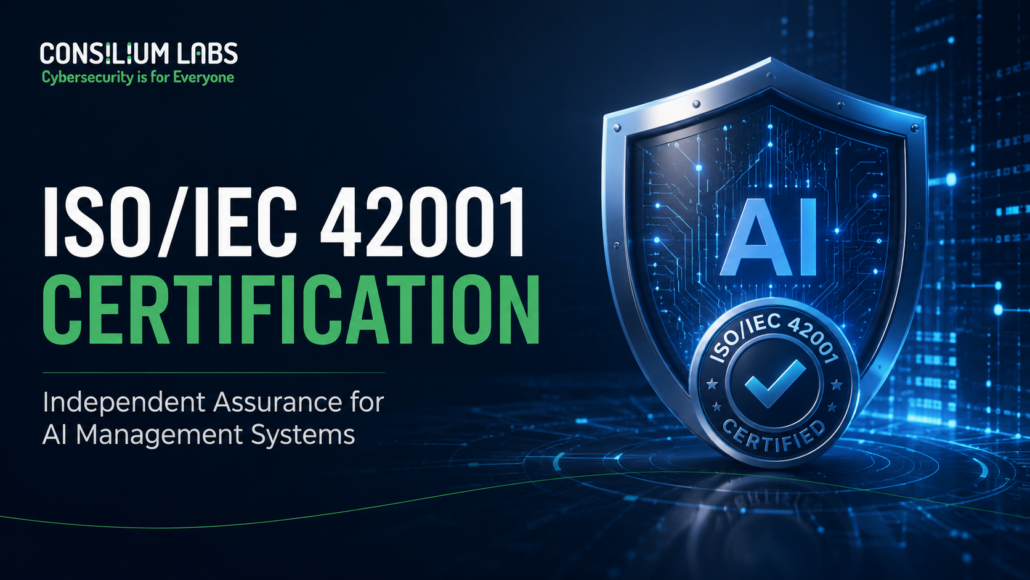
ISO/IEC 42001 Certification: Independent Assurance for AI Management Systems
- Shaheer Tariq
Why ISO/IEC 42001 Certification Now Belongs in the Boardroom
AI systems can influence decisions that affect customers, employees, suppliers, regulators, and markets. They can classify information, recommend actions, generate content, detect anomalies, screen applicants, summarize records, and evaluate risk.
These capabilities create operational value, but they also introduce governance questions that cannot be left to technical teams alone.
Leaders need clear answers to questions such as:
- Which AI systems fall within scope?
- Who owns AI-related decisions?
- How are AI risks evaluated?
- What records demonstrate oversight?
- How is human involvement defined for significant decisions?
- How are third-party AI tools evaluated?
- How are AI-related changes recorded over time?
ISO/IEC 42001 creates a management-system structure for addressing these questions through defined scope, documented responsibilities, risk records, lifecycle controls, monitoring, and management review.
What ISO/IEC 42001 Certification Evaluates Through an AIMS
ISO/IEC 42001 establishes requirements for an Artificial Intelligence Management System. In practical terms, this means AI governance becomes more than a policy statement.
It becomes a documented system of accountability.
An AIMS connects AI use cases with governance roles, risk evaluation, operational records, human involvement, third-party dependencies, and evidence of review.
This matters because AI risk is different from traditional technology risk. AI systems may produce biased outputs, drift over time, rely on sensitive data, generate inaccurate results, or produce outcomes that are difficult to explain. NIST’s AI Risk Management Framework is intended for voluntary use and focuses on incorporating trustworthiness considerations into AI products, services, and systems.
ISO/IEC 42001 provides the management-system structure for organizations that need AI governance to be assessed objectively.
How ISO/IEC 42001 Relates to the EU AI Act and NIST AI RMF
The AI governance environment is becoming more defined.
The EU AI Act entered into force on August 1, 2024, and uses a risk-based approach. The European Commission identifies high-risk examples such as AI-based medical software and AI systems used for recruitment, with requirements including risk-mitigation systems, high-quality datasets, clear user information, and human oversight.
NIST AI RMF is a voluntary framework for managing AI risk and incorporating trustworthiness considerations into AI systems.
ISO/IEC 42001 is different. It is an AI management system standard that can be assessed independently.
For organizations operating across regulated sectors, enterprise buyer environments, or international markets, these frameworks may be relevant at the same time. ISO/IEC 42001 provides a structured assessment pathway for demonstrating AI governance through evidence.
Sample Industry Use Cases
Healthcare: AI-Enabled Medical Devices
Healthcare organizations increasingly use AI-enabled technologies in medical imaging, diagnostics, monitoring, and clinical workflows.
The FDA maintains a public list of AI-enabled medical devices authorized for marketing in the United States. The FDA describes this list as a resource intended to identify AI-enabled medical devices that have been authorized for marketing.
A healthcare assessment may examine whether the intended clinical use is documented, responsibility for validating AI-generated outputs is assigned, human review requirements are defined, performance changes are monitored, and incidents or unsafe outputs are escalated.
Finance: AI in Securities and Risk Functions
Financial institutions use AI across customer communications, surveillance, investment processes, operational functions, fraud detection, and risk-related activities.
FINRA notes that broker-dealers are evaluating or using AI across customer communications, investment processes, and operational functions, including surveillance and monitoring of structured and unstructured data.
For financial environments, ISO/IEC 42001 becomes relevant where AI influences risk scoring, monitoring, customer outcomes, regulated workflows, or decision processes. Traceable records and defined accountability are central to credible evaluation.
Manufacturing: Predictive Maintenance and Quality Control
Manufacturers use AI for predictive maintenance, anomaly detection, demand forecasting, smart assembly, and quality control.
NIST identifies manufacturing AI use cases that include predictive maintenance, quality control, demand forecasting, and other operational applications.
For manufacturers, ISO/IEC 42001 can establish a management-system structure for documenting where AI is used, how risks are evaluated, how records are maintained, and how oversight is applied across the AI lifecycle.
Professional Services: Generative AI and Knowledge Work
Professional services firms increasingly use generative AI to summarize documents, analyze records, draft internal materials, review information, and organize knowledge.
These use cases raise governance questions around accuracy, confidentiality, data exposure, human review, third-party AI tools, and recordkeeping.
ISO/IEC 42001 gives professional services organizations a structured framework for defining AI scope, assigning accountability, documenting risk evaluation, and maintaining evidence of oversight.
What Consilium Labs Evaluates
Consilium Labs evaluates whether the defined AIMS conforms to the requirements of ISO/IEC 42001 within the agreed audit scope, including the organization’s selection, implementation and justification of relevant controls.
Our role is to evaluate the defined Artificial Intelligence Management System objectively within the agreed scope. This includes review of evidence, documentation, records, and management-system elements relevant to ISO/IEC 42001.
Assessment activities may include review of:
- Organizational context and interested-party requirements
- AI policy and measurable objectives
- AI risk assessment and treatment
- AI system impact assessments
- AI system inventory and intended-use documentation
- Statement of Applicability and control justification
- Competence and awareness
- Data governance and data quality
- AI system lifecycle processes
- Monitoring, measurement and internal audit
- Management review
- Corrective action and continual improvement
- Supplier and third-party AI governance
The audit results in a formal report documenting the audit scope, evidence reviewed, findings, nonconformities, and the audit team’s conclusion regarding conformity of the AIMS with ISO/IEC 42001. Any certification decision is made separately through an independent review process.
This distinction matters. Consilium Labs does not design AI controls, execute internal AI governance processes, or manage remediation. Our role is independent, evidence-based evaluation against applicable requirements.
Why Independent ISO/IEC 42001 Certification Assessment Matters
AI governance increasingly requires more than internal claims.
Enterprise buyers, boards, regulators, and stakeholders are looking for credible evidence that AI systems are governed with accountability, transparency, risk evaluation, and documented oversight.
Independent ISO/IEC 42001 assessment provides that external validation.
It creates a recognized assurance outcome grounded in objective evaluation, formal audit evidence, and documented results.
For organizations adopting AI across products, services, operations, or decision workflows, ISO/IEC 42001 provides a structured pathway for demonstrating responsible AI governance.
FAQs
What is ISO/IEC 42001?
ISO/IEC 42001 is an international AI management system standard. It specifies requirements for an Artificial Intelligence Management System within organizations that develop, provide, or use AI-based products or services.
Who should consider ISO/IEC 42001 assessment?
ISO/IEC 42001 is relevant for organizations using AI in products, services, operations, analytics, customer workflows, workforce decisions, regulated processes, or third-party AI tools.
What does an ISO/IEC 42001 assessment evaluate?
An ISO/IEC 42001 assessment evaluates whether the defined AIMS conforms to applicable requirements. This may include scope, governance roles, risk records, lifecycle documentation, monitoring, human involvement, management review, and evidence traceability.
Is ISO/IEC 42001 only for technology companies?
No. ISO/IEC 42001 applies across sectors. Healthcare, finance, manufacturing, professional services, public services, education, logistics, SaaS, and enterprise technology organizations may all use AI systems that require structured governance.
How is ISO/IEC 42001 different from ISO/IEC 27001?
ISO/IEC 27001 addresses the confidentiality, integrity and availability of information through an Information Security Management System. ISO/IEC 42001 addresses the governance and management of AI systems, including AI-specific risks, impacts, lifecycle responsibilities, transparency, data considerations, monitoring and human oversight. Both may be relevant when AI systems depend on sensitive data, secure systems, and documented operational controls.
How does ISO/IEC 42001 relate to the EU AI Act?
The EU AI Act is a legal framework. ISO/IEC 42001 is an AI management system standard. Organizations may evaluate ISO/IEC 42001 as part of broader AI governance planning where legal, regulatory, and enterprise assurance expectations intersect.
What is the outcome of an ISO/IEC 42001 assessment?
The audit results in a formal report documenting audit findings, including any identified nonconformities. Where the assessment is conducted as part of a certification process, certification may be granted following satisfactory resolution of applicable nonconformities and an independent certification review and decision.
Conclusion
AI governance has entered the boardroom.
As AI becomes embedded in decision-making, operations, products, and customer interactions, organizations need a structured way to demonstrate accountability, transparency, risk evaluation, human involvement, and evidence discipline.
ISO/IEC 42001 provides that structure through an Artificial Intelligence Management System.
Consilium Labs conducts independent, evidence-based ISO/IEC 42001 assessments and issues formal audit reports documenting conformities and nonconformities.


Related Articles
Let's get in touch
Start your audit now. Achieving cybersecurity audit can be complex. We have made it our mission to simplify the process, giving you access to the professional expertise you need to prepare your company for the future. Get in touch with us today!