In this article
NIST CSF 2.0 in 2026: Cybersecurity Governance Moves Closer to the Enterprise Core
Why the next phase of CSF 2.0 is less about adopting a framework and more about demonstrating how cybersecurity risk is actually governed
- Sajjad Syed
Two Years After Launch, CSF 2.0 Is Entering a More Operational Phase
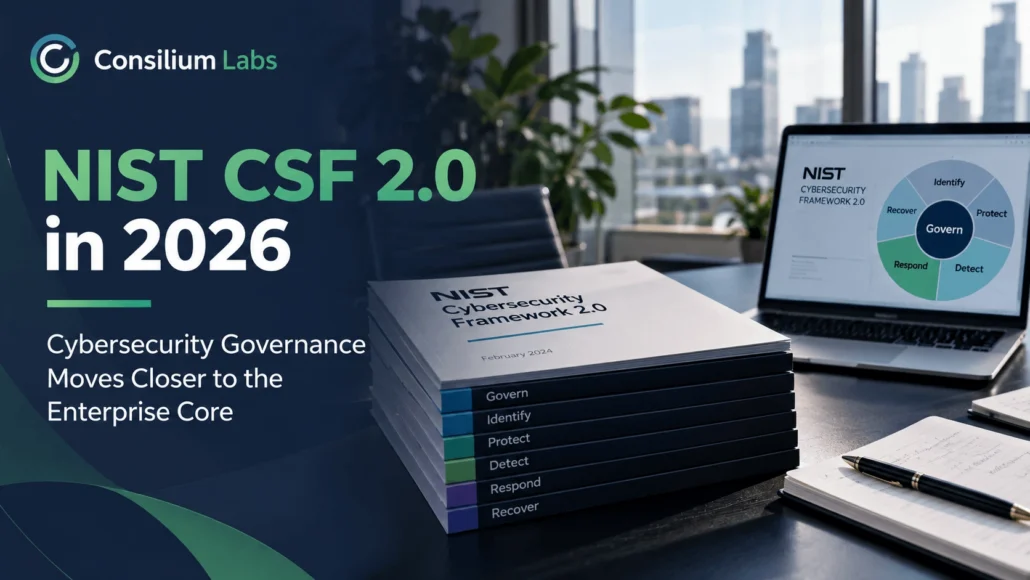
When the National Institute of Standards and Technology released Cybersecurity Framework 2.0 in February 2024, much of the attention centered on one major structural change: the addition of Govern alongside Identify, Protect, Detect, Respond, and Recover. The change brought executive accountability, policy, cybersecurity risk strategy, roles, oversight, and supply-chain risk more explicitly into the framework’s core architecture (Pascoe et al., 2024).
By 2026, the significance of that change is becoming easier to see. NIST reported in February that CSF 2.0 had surpassed three million views and downloads and was being used across organizations of different sizes, sectors, and geographies (Quinn, 2026). More important than the download count, however, is the ecosystem that has developed around the framework.
NIST has continued to publish resources connecting CSF 2.0 with enterprise risk management, workforce management, ransomware, sector-specific cyber risks, Informative References, and emerging uses of artificial intelligence. The direction suggests that CSF 2.0 is increasingly functioning as a common structure for translating cybersecurity risk across technical, operational, procurement, executive, and board-level conversations.
Consilium Labs operates as an A2LA-accredited inspection body under ISO/IEC 17020:2012. CSF 2.0 assessment engagements are defined through clear scope boundaries, applicable criteria, objective evidence, documented findings, and formal reporting. This inspection-body posture places independence and evidence at the center of the evaluation.
For enterprises, that distinction matters. The central question is increasingly less about whether an organization says it follows the NIST Cybersecurity Framework and more about whether its cybersecurity governance and operational outcomes can be demonstrated through traceable evidence.
Govern Is Becoming the Framework’s Most Consequential Addition
CSF 2.0 is organized around six Functions: Govern, Identify, Protect, Detect, Respond, and Recover. These Functions represent high-level cybersecurity outcomes rather than a prescribed sequence of technical controls. NIST deliberately designed the framework around outcomes, leaving organizations flexibility in determining how those outcomes are achieved within their operating context (Pascoe et al., 2024).
The addition of Govern substantially changed that context.
Under Govern, cybersecurity risk strategy, expectations, policy, responsibilities, oversight, and supply-chain risk are treated as integral parts of cybersecurity itself. This places questions traditionally distributed across multiple functions — such as risk ownership, executive accountability, supplier governance, policy authority, and escalation — within the same framework as detection, access protection, incident response, and recovery.
That matters because sophisticated cybersecurity environments can still produce weak assurance when responsibility is fragmented. Technical safeguards may function effectively while governance decisions remain inconsistently documented, risk ownership is unclear, or supplier cybersecurity obligations are managed separately from enterprise risk.
CSF 2.0 gives organizations a structure for examining those relationships together. For boards and executive teams, the framework provides a vocabulary for discussing cybersecurity as enterprise risk. For security teams, it creates clearer relationships between technical activity and organizational expectations. For independent assessment, it establishes defined outcomes against which governance and operational evidence can be evaluated.
Cybersecurity, Enterprise Risk, and Workforce Management Are Converging
One of the more important CSF developments in 2026 came in March, when NIST published Special Publication 1308, connecting cybersecurity risk management, enterprise risk management, and workforce management.
The publication reflects an increasingly practical reality: cybersecurity outcomes depend on more than technology. They also depend on decision authority, workforce capability, risk ownership, communication between business functions, and the way organizational resources correspond to identified risk (Quinn et al., 2026).
That connection is particularly relevant for medium and large enterprises. Cybersecurity risk often spans infrastructure, product teams, legal functions, procurement, privacy, operations, finance, executive leadership, and third-party relationships. A framework confined to the security department would provide only a partial view of how those risks are actually governed.
CSF 2.0 increasingly functions as a connective structure between these functions. Evidence relevant to an assessment may therefore exist well beyond the security team. Risk registers, executive reporting, workforce responsibility matrices, supplier records, incident documentation, cybersecurity metrics, asset inventories, recovery records, and organizational policies can all contribute to understanding whether defined CSF outcomes are being demonstrated.
For independent assessment, this creates a more realistic representation of enterprise cybersecurity. The evaluation considers how cybersecurity outcomes operate across the defined organizational environment rather than limiting the examination to a technical inventory of safeguards.
Organizational Profiles Are Making CSF 2.0 More Specific
Another important development is the growing relevance of Organizational Profiles.
NIST defines an Organizational Profile as a description of an organization’s current or target cybersecurity posture using outcomes from the CSF Core. Profiles allow organizations to contextualize the framework according to mission objectives, stakeholder expectations, the threat landscape, and applicable requirements (Pascoe et al., 2024).
This is significant because CSF 2.0 is intentionally broad. The cybersecurity priorities of a SaaS company serving financial institutions will differ from those of a manufacturer operating industrial systems or a healthcare technology business managing sensitive information.
A Profile makes that difference explicit.
An organization may document a Current Profile reflecting observed outcomes and a Target Profile reflecting selected cybersecurity objectives. Those Profiles can create a more precise basis for internal risk discussions and independent assessment because the organization has identified which outcomes are relevant to the environment being evaluated.
Rather than asking whether an enterprise broadly “meets CSF 2.0,” an assessment can examine defined cybersecurity outcomes within a specified scope and organizational context.
Community Profiles Are Taking CSF 2.0 Into Specific Risk Environments
The expansion of Community Profiles is another indication of how CSF 2.0 is becoming more operational.
Community Profiles establish baseline CSF outcomes around shared industries, technologies, threats, or operating environments. By September 2026, NIST’s profile library included material addressing manufacturing, semiconductors, incident response, ransomware, genomic data, telecommunications, financial services, cloud environments, artificial intelligence, and other specialized contexts (National Institute of Standards and Technology [NIST], 2026c).
This expansion matters because the same high-level framework can now be interpreted through increasingly specific risk lenses.
A manufacturer can consider CSF outcomes in an industrial environment. A financial organization can evaluate cybersecurity against sector-specific priorities. A company concerned with ransomware can focus on outcomes directly relevant to that threat. Organizations operating AI systems can increasingly examine the interaction between cybersecurity and AI-specific risk.
The result is a framework that remains broadly applicable while allowing organizations to place selected cybersecurity outcomes within a more precise business or risk context.
Where a Community Profile is formally incorporated into defined assessment criteria, it can provide additional context for independent evaluation. The assessment remains tied to the agreed scope and criteria rather than generalized assumptions about the organization’s cybersecurity posture.
Ransomware Shows How CSF 2.0 Can Move From Framework to Defined Threat Context
NIST’s June 2026 publication of a revised Ransomware Risk Management CSF 2.0 Community Profile illustrates this shift clearly.
The publication maps relevant CSF 2.0 outcomes across governance, identification, protection, detection, response, and recovery in the context of ransomware events (Fisher et al., 2026). Its significance extends beyond ransomware itself. It demonstrates how the CSF can be translated from enterprise-level cybersecurity outcomes into a structure for examining a specific threat environment.
For leadership teams, this can make cybersecurity discussions more concrete. Ransomware becomes more than an endpoint-security or backup issue. The CSF structure places governance, asset identification, protective measures, detection, response processes, and recovery within the same risk conversation.
For organizations with significant ransomware exposure, a defined assessment can examine how multiple cybersecurity Functions operate together. Governance records, asset information, monitoring evidence, incident processes, and recovery practices can then be evaluated against the selected outcomes established for the scope.
Informative References Are Making Cross-Framework Analysis More Practical
Another 2026 development received less public attention but may prove highly relevant to enterprises operating under multiple standards.
In August, NIST finalized Special Publication 1347 on Informative References. These references identify relationships between CSF outcomes and elements of other cybersecurity documents, giving organizations a structured mechanism for examining relationships between CSF 2.0 and other standards or control sources (Quinn et al., 2026).
This is particularly relevant for organizations operating under overlapping customer, contractual, regulatory, and industry requirements.
A technology company may use CSF 2.0 for enterprise cybersecurity governance while maintaining separate requirements for information security, privacy, federal contracting, cloud environments, or sector-specific controls. Informative References make those relationships easier to examine without treating separate frameworks as interchangeable.
That distinction is essential. Similar cybersecurity concepts may appear across several frameworks, but each framework retains its own scope, criteria, terminology, and outcome.
Within an assessment environment, mappings can provide useful context while conclusions remain grounded in the criteria formally defined for the engagement.
AI Is Beginning to Enter CSF Analysis — Carefully
Artificial intelligence is now influencing the CSF ecosystem in another way.
In August 2026, NIST published an initial public draft of Special Publication 1353 examining possible uses of AI for CSF analysis and reporting. The draft addresses potential applications involving governance review, Current Profiles, Target Profiles, planning, monitoring, and analysis. Public comments remain open through October 15, 2026, meaning the publication should be treated as developing material rather than finalized NIST practice (NIST, 2026b).
The development is notable because it reflects a broader shift in enterprise cybersecurity: organizations are beginning to consider AI both as a technology requiring governance and as a tool that may be applied within governance and risk processes.
CSF 2.0 and the NIST AI Risk Management Framework address different concerns, but the two can intersect around governance, risk ownership, accountability, monitoring, and third-party technology exposure.
As organizations explore AI-assisted analysis, the integrity of evidence, defined assessment criteria, documented scope, professional judgment, and traceability of conclusions remain central to credible evaluation.
Supply-Chain Cybersecurity Is Moving Further Into Enterprise Governance
Third-party technology dependence has changed the context in which CSF 2.0 is used.
Modern enterprises depend heavily on cloud providers, SaaS platforms, infrastructure services, software suppliers, contractors, managed providers, and increasingly AI vendors. A substantial portion of organizational cybersecurity exposure may therefore exist outside infrastructure that the enterprise directly controls.
CSF 2.0 increased the framework’s emphasis on cybersecurity supply-chain risk when it was released in 2024 (Pascoe et al., 2024). Within the broader governance structure, supplier cybersecurity becomes part of how enterprise risk is identified, assigned, monitored, and communicated.
For a CSF 2.0 assessment, relevant evidence may include supplier classification methods, contractual cybersecurity requirements, third-party evaluation records, dependency inventories, incident escalation arrangements, and governance records showing how material supplier risk reaches appropriate decision-makers.
This is particularly relevant for SaaS and technology-driven enterprises whose customer commitments depend on extensive ecosystems of external services.
What an Independent CSF 2.0 Assessment Examines
A Consilium Labs CSF 2.0 assessment begins with a defined assessment boundary and agreed criteria. Depending on the scope, the evaluation may address selected Functions, Categories, Subcategories, an Organizational Profile, or another formally established set of CSF outcomes.
Assessment activities examine objective evidence demonstrating how those outcomes operate in practice. Relevant evidence may include governance policies, cybersecurity risk registers, executive reporting, asset inventories, supplier records, access control records, security monitoring outputs, incident documentation, recovery procedures, organizational responsibilities, performance metrics, and other records connected to the defined criteria.
Interviews may also form part of the evidence process where confirmation of responsibilities or operational practices is necessary.
The engagement concludes with formal reporting documenting the applicable criteria, evidence examined, and observed conformity and nonconformity within the agreed scope.
The credibility of the assessment rests on objective evidence, traceable findings, and a clearly defined relationship between observed practices and the criteria against which they were evaluated.
Industry Use Cases
B2B SaaS: Enterprise Customers Are Looking Beyond Individual Controls
A SaaS provider serving regulated enterprises may already maintain extensive information security documentation, technical testing records, and recognized certifications. Yet large customers increasingly ask questions that span the wider governance environment: Who owns cybersecurity risk? How are material risks escalated? How are critical suppliers evaluated? How are incidents communicated? How does leadership receive evidence about cybersecurity performance?
A CSF 2.0 assessment can examine those questions within one risk-based structure. For a SaaS organization, the scope may include governance, cloud dependencies, access control, incident management, monitoring, recovery, and third-party relationships.
The resulting assessment report documents findings against selected CSF outcomes, providing a traceable record of the environment evaluated within the defined scope.
Financial Services: Connecting Cybersecurity to Enterprise Risk
Financial institutions frequently manage cyber risk alongside operational resilience, fraud risk, privacy obligations, business continuity, and third-party exposure. Treating cybersecurity as a separate technical domain can make executive oversight fragmented.
CSF 2.0 provides a common structure for examining how cybersecurity risk enters enterprise governance. An independent assessment may evaluate how risk is assigned, reported, monitored, and connected to operational processes, as well as how detection, incident response, supplier oversight, and recovery evidence correspond to selected framework outcomes.
For executive leadership, this provides a formal assessment record of how the cybersecurity governance structure operates across multiple business functions within the defined scope.
Healthcare Technology: Evaluating Security Across Connected Environments
Healthcare technology organizations frequently operate combinations of cloud platforms, APIs, mobile applications, connected devices, analytics systems, sensitive data environments, and external providers. These components create cybersecurity dependencies that can cross technical and organizational boundaries.
A CSF 2.0 assessment can evaluate governance, asset identification, access protection, monitoring, incident response, recovery, and supplier relationships within an agreed environment.
The resulting report provides documented findings showing how selected cybersecurity outcomes were evidenced across the systems and processes included in the assessment boundary.
Manufacturing: Extending Cybersecurity Governance Into Operational Technology
Manufacturing environments often bring together traditional IT, operational technology, industrial systems, remote access, production networks, suppliers, and specialized equipment. Cybersecurity risk in these environments can have consequences extending well beyond information systems.
CSF 2.0 provides a structure for examining cybersecurity outcomes across that broader operating environment. A defined assessment may evaluate governance responsibilities, asset visibility, segmentation evidence, third-party dependencies, monitoring, incident processes, and recovery mechanisms.
Manufacturing-specific Community Profile material can also provide additional context where formally incorporated into the defined assessment criteria.
Vendor-Dependent Enterprises: Bringing Third-Party Risk Into the Same Risk Conversation
A technology-driven enterprise may rely on hundreds of external services while directly controlling only a portion of the systems involved in delivering its products and operations.
Vendor questionnaires may provide information about individual providers, but enterprise cybersecurity governance also requires evidence showing how material supplier risk is managed across the organization.
A CSF 2.0 assessment may examine how critical vendors are identified, how cybersecurity obligations are documented, how supplier risk is escalated, how dependencies are incorporated into incident processes, and whether executive reporting reflects material third-party exposure.
This places supplier risk within the same governance structure used to evaluate internal cybersecurity outcomes.
Frequently Asked Questions
What is NIST CSF 2.0?
NIST Cybersecurity Framework 2.0 is a voluntary, risk-based framework for managing and communicating cybersecurity risk. Its Core is organized around six Functions: Govern, Identify, Protect, Detect, Respond, and Recover. The framework is designed for organizations across sectors, sizes, and levels of cybersecurity maturity (Pascoe et al., 2024).
What was the biggest change from CSF 1.1?
The addition of Govern was the most visible structural change. CSF 2.0 also broadened the framework beyond its original critical-infrastructure emphasis, expanded attention to supply-chain cybersecurity, revised Categories and Subcategories, and developed a larger ecosystem of Profiles, Informative References, and implementation resources.
Is CSF 2.0 a certification standard?
CSF 2.0 is a voluntary cybersecurity risk management framework designed to organize, evaluate, and communicate cybersecurity outcomes. Independent assessment can evaluate defined CSF 2.0 criteria and produce documented findings within an agreed scope; CSF 2.0 itself is distinct from a certification standard.
What are the six CSF 2.0 Functions?
The six Functions are Govern, Identify, Protect, Detect, Respond, and Recover. They are designed to operate together rather than as a simple linear sequence. Govern addresses cybersecurity risk strategy, expectations, and policy, while the other Functions cover understanding assets and risk, safeguarding systems, identifying events, responding to incidents, and restoring affected capabilities (Pascoe et al., 2024).
What is an Organizational Profile?
An Organizational Profile describes selected CSF outcomes in the context of an organization’s mission, stakeholder expectations, risk environment, and requirements. Organizations can establish Current and Target Profiles to document observed outcomes and selected objectives.
What are CSF 2.0 Tiers?
The four Tiers — Partial, Risk Informed, Repeatable, and Adaptive — characterize the rigor of cybersecurity risk governance and management. They provide context for Organizational Profiles rather than functioning as certification levels (Quinn et al., 2024).
Can CSF 2.0 address ransomware risk?
CSF 2.0 can be applied to ransomware risk through defined cybersecurity outcomes. In June 2026, NIST published a revised Ransomware Risk Management CSF 2.0 Community Profile identifying relevant outcomes across the framework’s six Functions (Fisher et al., 2026).
How does CSF 2.0 relate to AI?
CSF 2.0 can apply to technology environments that include AI systems. NIST also published an initial public draft in August 2026 examining potential uses of AI for CSF analysis and reporting. As of September 2026, that publication remains under public review and should be distinguished from finalized NIST material (NIST, 2026b).
Can CSF 2.0 be assessed alongside another NIST framework?
AI systems can increase the volume, complexity, and number of processing relationships involving personal information. ISO/IEC 27701 provides a formal privacy governance structure around PII even when processing occurs across AI-enabled systems and external technology ecosystems.
What does Consilium Labs provide at the conclusion of a CSF 2.0 assessment?
Consilium Labs provides formal assessment reporting documenting the defined criteria, evidence reviewed, and observed conformity and nonconformity within the agreed scope.
CSF 2.0 Is Becoming More Relevant as Cybersecurity Becomes More Distributed
The trajectory of CSF 2.0 since 2024 shows a framework moving deeper into enterprise governance rather than remaining primarily a security-team reference.
The expansion of Organizational and Community Profiles, closer connections to enterprise risk and workforce management, ransomware-specific material, supply-chain emphasis, Informative References, and emerging AI applications all point in the same direction. Cybersecurity risk is becoming more distributed across the enterprise, while expectations for accountability are becoming more explicit.
That makes evidence increasingly important.
An organization can adopt the terminology of CSF 2.0 relatively easily. Demonstrating how its governance, risk processes, technical activities, supplier relationships, response capabilities, and recovery mechanisms correspond to defined CSF outcomes requires disciplined evaluation against established criteria.
Independent assessment provides a documented record of that distinction.
Consilium Labs conducts CSF 2.0 assessments using defined scope, applicable criteria, objective evidence, documented findings, and formal reporting to provide an independent view of cybersecurity governance and operational outcomes.
Define Your CSF 2.0 Assessment Scope
If your organization is evaluating NIST CSF 2.0, enterprise cybersecurity governance, supply-chain risk, or an independent cybersecurity assessment, schedule a scope conversation with Consilium Labs:
References
Fisher, W., Souppaya, M., Barker, W., & Kent, K. (2026). Ransomware risk management: A Cybersecurity Framework 2.0 Community Profile (NIST IR 8374 Rev. 1). National Institute of Standards and Technology. https://doi.org/10.6028/NIST.IR.8374r1
National Institute of Standards and Technology. (2026). CSF 2.0 Profiles. U.S. Department of Commerce.
National Institute of Standards and Technology. (2026). NIST Cybersecurity Framework 2.0: Quick-Start Guide for Using Artificial Intelligence (AI) for CSF Analysis and Reporting (NIST SP 1353, Initial Public Draft). U.S. Department of Commerce.
Pascoe, C., Quinn, S., & Scarfone, K. (2024). The NIST Cybersecurity Framework (CSF) 2.0 (NIST CSWP 29). National Institute of Standards and Technology. https://doi.org/10.6028/NIST.CSWP.29
Quinn, S. (2026, February 24). Celebrating two years of CSF 2.0! National Institute of Standards and Technology.
Quinn, S., Eliot, D., Prebil, M., Witte, G., & Smith, M. (2026). NIST Cybersecurity Framework 2.0: Cybersecurity, enterprise risk management, and workforce management Quick-Start Guide (NIST SP 1308). National Institute of Standards and Technology. https://doi.org/10.6028/NIST.SP.1308
Quinn, S., Eliot, D., Witte, G., & Hoehn, B. (2026). NIST Cybersecurity Framework 2.0: Informative References Quick-Start Guide (NIST SP 1347). National Institute of Standards and Technology. https://doi.org/10.6028/NIST.SP.1347
Quinn, S., Pascoe, C., Barrett, M., Scarfone, K., & Witte, G. (2024). NIST Cybersecurity Framework 2.0: Quick-Start Guide for Using the CSF Tiers (NIST SP 1302). National Institute of Standards and Technology. https://doi.org/10.6028/NIST.SP.1302
Author Bio
Sajjad Syed is Technical Manager and Auditors Team Lead at Consilium Labs. His work covers independent cybersecurity and governance assessments involving NIST frameworks, information security, AI governance, technical evaluation, and enterprise risk. He focuses on structured assessment execution, objective evidence review, and formal reporting aligned with recognized standards.


Related Articles
Let's get in touch
Start your audit now. Achieving cybersecurity audit can be complex. We have made it our mission to simplify the process, giving you access to the professional expertise you need to prepare your company for the future. Get in touch with us today!